
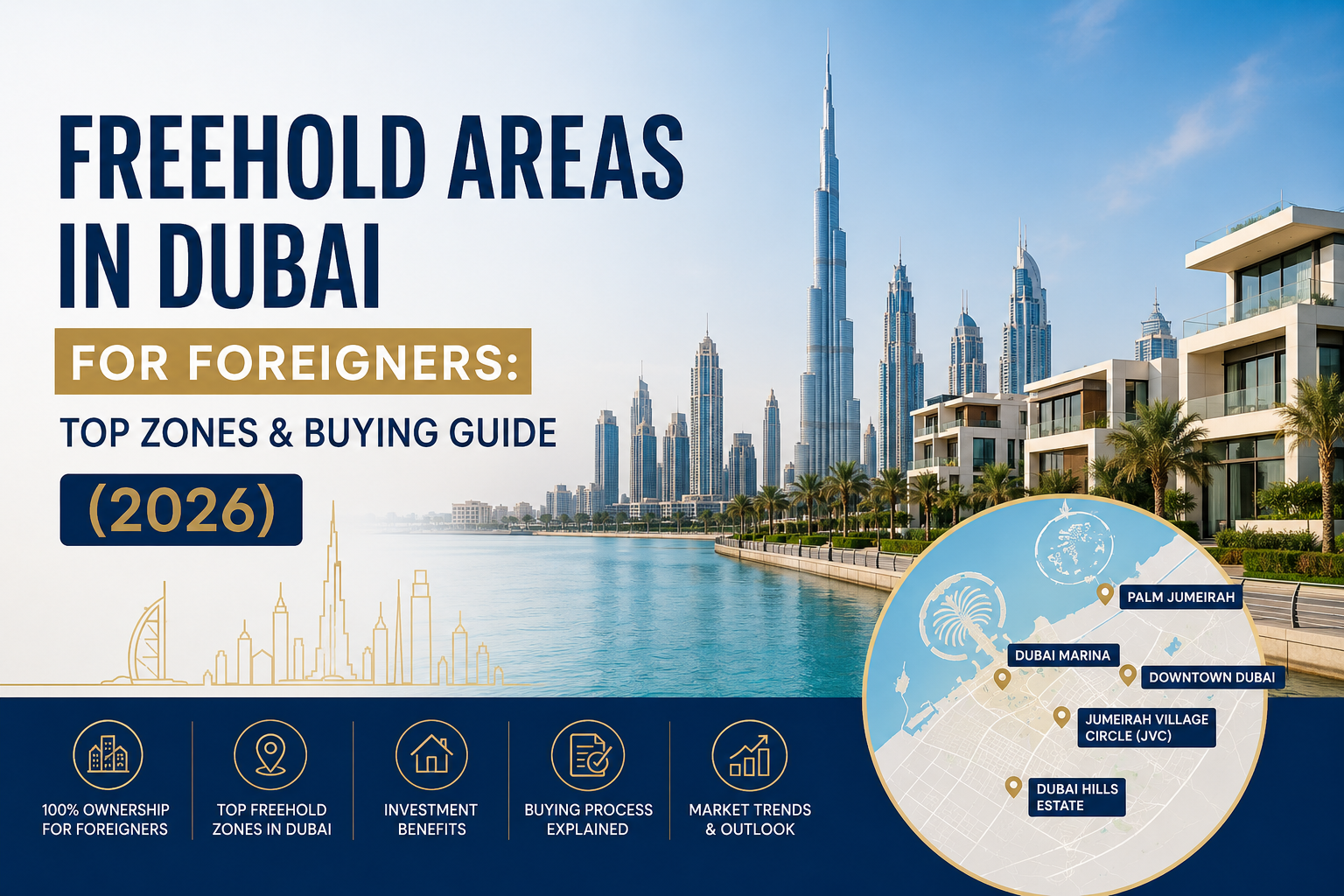
Can Foreigners Buy Property in Dubai?
Dubai has established itself as one of the most attractive real estate markets in the world for foreign investors and residents. In 2002, the UAE government made a landmark decision that changed the property landscape forever — allowing non-UAE nationals to own property in designated freehold areas in Dubai. Since then, the city has witnessed a dramatic surge in foreign real estate investment, with billions of dirhams flowing in from investors across Europe, Asia, the Americas, and beyond.
If you are a foreign national wondering whether you can buy property in Dubai, the short answer is yes — but only in specifically designated freehold zones. This guide covers everything you need to know about freehold areas in Dubai for foreigners, including where to buy, what it costs, legal requirements, and tips for making a smart investment.
What Is Freehold Property in Dubai?
Before exploring specific freehold areas, it is important to understand what freehold ownership means in the Dubai context.
Freehold ownership gives the buyer full ownership rights over both the property and the land it sits on — indefinitely, without any time limit. As a freehold owner, you have the right to sell, lease, mortgage, or transfer the property to your heirs.
Leasehold ownership, by contrast, grants the right to use a property for a fixed period — typically 10, 50, or 99 years — after which ownership reverts back to the freeholder. Foreigners are not permitted to purchase leasehold properties in the same way.
The key distinction for foreign nationals: only freehold properties in designated zones are available for outright purchase by non-UAE and non-GCC nationals.
Top Freehold Areas in Dubai for Foreigners (2025)
The Dubai Land Department (DLD) has officially designated over 60 areas across the emirate as freehold zones. Below are the most popular and high-value options for foreign buyers:
| Freehold Area | Location / Zone | Avg. Price (1 BHK, AED) |
| Dubai Marina | New Dubai / JBR Waterfront | 900,000 – 1,800,000 |
| Downtown Dubai | City Centre / Burj Khalifa Area | 1,200,000 – 3,500,000 |
| Palm Jumeirah | Offshore Island / Luxury | 1,500,000 – 5,000,000+ |
| Business Bay | City Centre / Canal Views | 800,000 – 1,600,000 |
| Jumeirah Village Circle | New Dubai / Affordable | 500,000 – 900,000 |
| Arabian Ranches | Dubailand / Villas | 1,400,000 – 3,000,000 |
| Dubai Hills Estate | Mohammed Bin Rashid City | 900,000 – 4,500,000 |
| Jumeirah Lakes Towers | New Dubai / Cluster | 600,000 – 1,200,000 |
| The Springs / Meadows | Emirates Living / Villas | 1,200,000 – 2,500,000 |
| City Walk | Al Wasl / Boutique Living | 1,300,000 – 3,000,000 |
* Prices are indicative averages for 2025 and vary by developer, floor, view, and market conditions.
Detailed Breakdown of the Best Freehold Areas in Dubai for Foreigners
1. Dubai Marina — Best for Waterfront Living
Dubai Marina is one of the most popular freehold zones for foreign buyers and remains consistently in the top three most searched areas on property portals. Built around an artificial canal, it is home to over 200 residential towers, making it one of the world’s tallest and densest urban waterfront developments.
Foreign buyers are drawn to Dubai Marina for its walkability, proximity to the beach at JBR (Jumeirah Beach Residence), and robust rental demand — making it an excellent choice for buy-to-let investors. Gross rental yields typically range between 5% and 7% annually.
- Property types: Apartments (studios to penthouses)
- Key developers: Emaar, DAMAC, Select Group
- Ideal for: Young professionals, expat renters, short-term rental investors
2. Downtown Dubai — Best for Prestige & Capital Growth
Home to the iconic Burj Khalifa, Dubai Mall, and Dubai Fountain, Downtown Dubai is the emirate’s most prestigious address. Properties here command a premium, but they also offer strong long-term capital appreciation and attract a high-end tenant profile.
For foreign investors seeking brand recognition and long-term value retention, Downtown Dubai remains a top-tier freehold option. Properties here rarely stay vacant for long, particularly those with Burj Khalifa or fountain views.
- Property types: Luxury apartments, serviced residences
- Key developers: Emaar Properties
- Ideal for: Luxury investors, high-net-worth individuals
3. Palm Jumeirah — Best for Ultra-Luxury
The Palm Jumeirah is one of the world’s most recognizable man-made islands and one of Dubai’s most exclusive freehold zones. Whether you are eyeing a seafront apartment in a Atlantis-facing building or a sprawling villa on the Palm’s frond, this area offers unmatched luxury and prestige.
Foreign buyers in Palm Jumeirah enjoy private beaches, five-star hotel amenities, and one of Dubai’s highest rental yields for high-end properties. The Palm also qualifies buyers for UAE residency visas when investment thresholds are met.
- Property types: Villas, townhouses, luxury apartments
- Key developers: Nakheel, DAMAC, Kerzner
- Ideal for: High-net-worth foreigners seeking lifestyle + investment
4. Jumeirah Village Circle (JVC) — Best for Affordable Investment
Jumeirah Village Circle has emerged as one of the most searched affordable freehold areas in Dubai for foreigners and first-time investors. Strategically located near major highways, JVC offers relatively lower entry prices compared to prime areas, while still delivering competitive rental yields.
The area has seen rapid development over the past five years, with new cafes, schools, supermarkets, and healthcare facilities improving its lifestyle appeal. For foreign nationals with a budget under AED 1 million, JVC often provides the best value.
- Property types: Studios, 1-3 BHK apartments, townhouses
- Key developers: Nakheel, Ellington, Sobha
- Ideal for: Budget-conscious investors, young families
5. Business Bay — Best for Urban Investment
Business Bay sits alongside the Dubai Water Canal and neighbours Downtown Dubai, making it one of the most strategically positioned freehold zones. Originally conceived as a commercial hub, it has evolved into a mixed-use district with strong residential demand.
Foreign buyers favour Business Bay for its proximity to the CBD, competitive pricing compared to Downtown, and strong demand from professionals working in the financial and corporate sector. Many branded residences by luxury hotel groups are also found here.
- Property types: Apartments, branded residences
- Key developers: Damac, Omniyat, Emaar
- Ideal for: Corporate professionals, mid-to-high budget investors
Legal Requirements for Foreigners Buying Freehold Property in Dubai
One of the key advantages of buying in Dubai freehold zones is the relative simplicity of the purchasing process. There are no restrictions based on nationality — any foreign national can purchase in designated zones, regardless of whether they are a UAE resident.
Key Legal Requirements
- No requirement to be a UAE resident to purchase freehold property
- A valid passport is the primary identification document needed
- No mortgage restriction law limits foreign ownership
- All transactions must be registered with the Dubai Land Department (DLD)
- A No Objection Certificate (NOC) from the developer is required for secondary market transactions
Costs to Factor In When Buying
- Beyond the property price itself, foreign buyers should budget for the following additional costs:
- Dubai Land Department Transfer Fee: 4% of the property value
- DLD Registration Fee: AED 2,000 – AED 4,000 (depending on value)
- Real Estate Agent Commission: Typically 2% of the purchase price
- Mortgage Registration Fee (if applicable): 0.25% of the loan amount
- Service Charges: Annual fee for maintenance of communal areas (varies by community)
Residency Visa Benefits for Foreign Property Owners
One of the most compelling reasons for foreign nationals to purchase freehold property in Dubai is the opportunity to obtain UAE residency visas tied to the investment. The UAE government offers several property-linked visa categories:
| Visa Type | Minimum Investment | Validity |
| 2-Year Property Visa | AED 750,000 (completed property) | 2 Years (renewable) |
| 5-Year Golden Visa | AED 2,000,000 (property value) | 5 Years (renewable) |
| 10-Year Golden Visa | AED 2,000,000+ (qualifying criteria) | 10 Years (renewable) |
The UAE Golden Visa program has made Dubai freehold property even more attractive for foreign nationals, as it provides long-term residency without the need for a local sponsor — a significant benefit compared to other residency options in the region.
Step-by-Step Guide: How to Buy Freehold Property in Dubai as a Foreigner
Step 1: Define Your Budget & Goals
Determine whether you are buying for personal use, rental income, or long-term capital growth. This will influence which freehold area and property type is most suitable for your needs.
Step 2: Choose Your Freehold Area
Use this guide to shortlist two or three freehold areas that match your lifestyle preferences, investment goals, and budget. Research current asking prices and rental yields on portals like Bayut, Property Finder, and Dubizzle.
Step 3: Engage a RERA-Registered Agent
Always work with a Real Estate Regulatory Authority (RERA)-certified agent. This provides legal protection and ensures your transaction is compliant with Dubai’s property laws.
Step 4: Sign a Memorandum of Understanding (MOU)
Once you agree on a price with the seller, a Memorandum of Understanding (Form F) is signed. At this stage, a deposit — typically 10% of the agreed purchase price — is paid.
Step 5: Obtain the No Objection Certificate (NOC)
The seller’s developer must issue an NOC confirming no outstanding service charges or developer dues on the property. This process typically takes 5–10 business days.
Step 6: Transfer Ownership at the Dubai Land Department
Both buyer and seller (or their representatives with a Power of Attorney) visit the DLD or a registered trustee office to complete the official transfer. The 4% transfer fee is paid at this stage and the new Title Deed is issued in the buyer’s name.
Frequently Asked Questions (FAQs)
Can any foreigner buy property in Dubai?
Yes. Any foreign national — whether or not they are a UAE resident — can purchase freehold property in Dubai within the designated freehold zones. There are no nationality-based restrictions.
Do I need to visit Dubai to buy property?
You do not need to be physically present in Dubai to purchase property. The process can be managed through a Power of Attorney (POA), with many transactions now facilitated online via the Dubai REST app and digital DLD platforms.
Is there property tax in Dubai?
Dubai does not levy annual property taxes, capital gains tax, or income tax on rental income for individuals. The primary cost at purchase is the 4% DLD transfer fee. This tax-efficient environment is a major draw for foreign investors.
What is the minimum property price for a UAE Golden Visa?
To qualify for the UAE Golden Visa through property investment, the minimum property value is AED 2,000,000 (approximately USD 545,000). The property must be fully paid (not mortgaged) or have a completed payment of at least AED 2 million if under mortgage.
Which freehold area in Dubai gives the highest rental yield?
Based on 2024–2025 data, Jumeirah Village Circle (JVC), Dubai Silicon Oasis, and International City consistently rank among the highest rental yield areas, often delivering gross yields of 7% to 9%. Premium areas like Palm Jumeirah and Downtown typically yield 4% to 6% but offer stronger capital appreciation.
Conclusion: Is Buying in a Dubai Freehold Area Right for You?
Dubai’s freehold property market offers foreign nationals a rare combination of full ownership rights, zero income tax, strong rental yields, residency visa benefits, and world-class lifestyle amenities — all within a regulated and transparent legal framework.
Whether you are a first-time buyer seeking an affordable apartment in Jumeirah Village Circle, a luxury investor eyeing a penthouse in Palm Jumeirah, or a professional looking for a strategic asset in Business Bay, the freehold areas in Dubai for foreigners provide an option for every budget and investment objective.
With over 60 officially designated freehold zones and a government that actively incentivizes foreign investment, Dubai remains one of the most accessible and investor-friendly real estate markets in the world in 2025.