
Quick Answer: Yes. Foreign nationals of all nationalities can buy property in Dubai with full freehold ownership rights in over 40 designated zones. No UAE visa, no local sponsor, and no residency is required to purchase. You need only a valid passport. The standard transfer fee is 4% of the purchase price paid to the Dubai Land Department (DLD), and the full process from signing the Memorandum of Understanding (MOU) to receiving your title deed takes two to six weeks for ready property. Investing AED 2 million or more may qualify you for a 10-year UAE Golden Visa.
Dubai has one of the most open foreign property ownership frameworks of any major global city. Since 2002, when Law No. 7 of 2006 and its predecessor regulations first permitted international buyers to hold freehold title, the market has grown to welcome buyers from over 180 nationalities. Dubai residential transaction volume grew 18% year-on-year in Q1 2026, reaching 42,800 total transactions, and international buyers consistently account for the majority of that volume.
The process is more straightforward than most first-time international buyers expect. There are no nationality restrictions, no age minimums beyond 21 years, no requirement to open a UAE bank account before buying, and no need to be present in Dubai to begin the process. This guide covers the legal framework, the step-by-step buying process, every fee you will pay, mortgage options for non-residents, and the visa pathways that property ownership unlocks.
Januss note: As a DLD-registered developer in Dubai’s Al Furjan freehold zone, we work with international buyers at every stage of this process. The information below reflects how it works in practice in 2026, including the parts that generic guides tend to gloss over.
Can Foreigners Buy Property in Dubai? The Legal Framework
Yes, with full freehold ownership rights in designated zones. The legal basis is Article 3 of Regulation No. 3 of 2006 issued by the Ruler of Dubai, which designates specific areas where non-GCC nationals may hold full title deed ownership. In freehold zones, you own the property and the land it sits on outright, with no expiry date, no local partner requirement, and no restriction on selling, leasing, or passing the property to heirs.
Outside these designated freehold zones, foreigners may hold leasehold interests of up to 99 years, but cannot hold full freehold title. For investment and residency purposes, freehold ownership in a designated zone is the relevant structure for most international buyers.
Freehold ownership: Full title deed in your name, registered with DLD. No expiry, no local partner, no sponsor. Available in 40+ designated zones across Dubai.
Leasehold ownership: Long-term lease right (up to 99 years). Title does not include the underlying land. Less common for foreign investment purposes.
Usufruct rights: Right to use and benefit from a property for a fixed period. Limited availability and practical use for foreign buyers.
Key rule: No UAE residency, no local sponsor, and no UAE bank account is required to purchase freehold property in Dubai. A valid passport is the only mandatory buyer identification document.
Where Can Foreigners Buy Property in Dubai? The Freehold Zones
Dubai has designated over 40 freehold areas where foreign nationals can hold full ownership. The full and current list is maintained by the DLD and can be verified through the Dubai REST app or dubailand.gov.ae. For the complete community-by-community breakdown, the freehold areas in Dubai guide covers every eligible zone with area profiles and current pricing.
The most active communities for international buyers in 2026 include:
| Community | Type | Price Range | Best For | Gross Yield |
| Dubai Marina | Apartments | AED 1.2M to 3M+ | Lifestyle, STR, waterfront | 5 to 7% |
| Downtown Dubai | Apartments | AED 1.5M to 5M+ | Capital appreciation, prime address | 4 to 6% |
| JVC | Apartments | AED 600K to 1.5M | Rental yield, affordability | 7 to 9% |
| Al Furjan | Apartments, villas | AED 900K to 2M | Mid-market yield, metro access | 7 to 9% |
| Palm Jumeirah | Apartments, villas | AED 2M to 15M+ | Premium lifestyle, brand value | 3.5 to 5% |
| Business Bay | Apartments | AED 900K to 2.5M | Capital growth, corporate tenants | 7 to 9% gross / 4 to 5% net |
| Dubai Hills Estate | Apts, villas, townhouses | AED 1.2M to 5M+ | Families, balanced yield and growth | 5 to 7% |
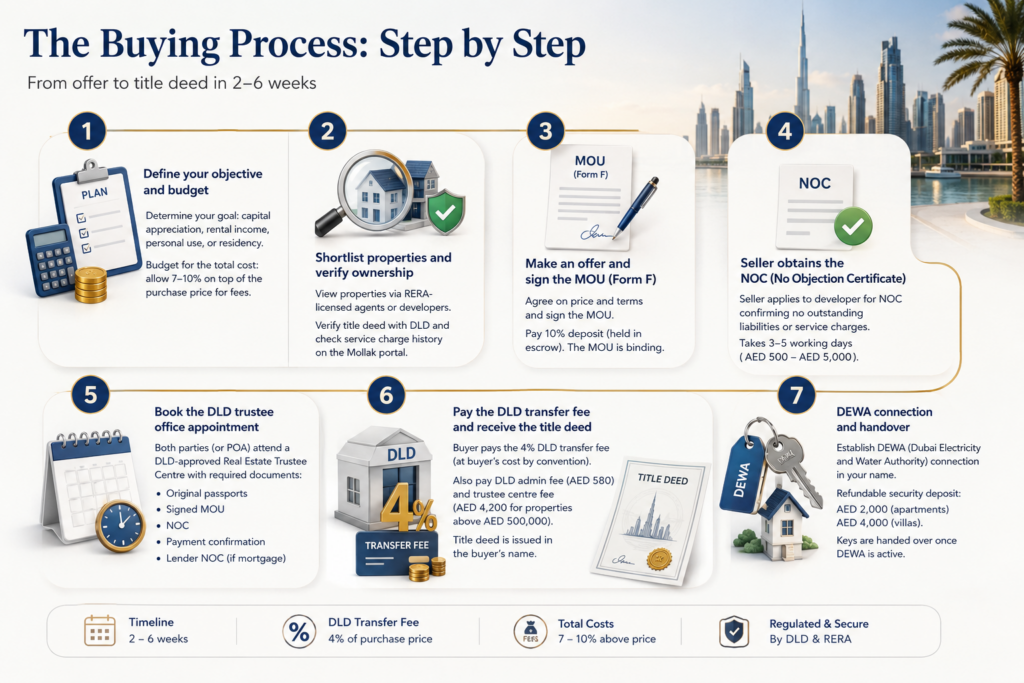
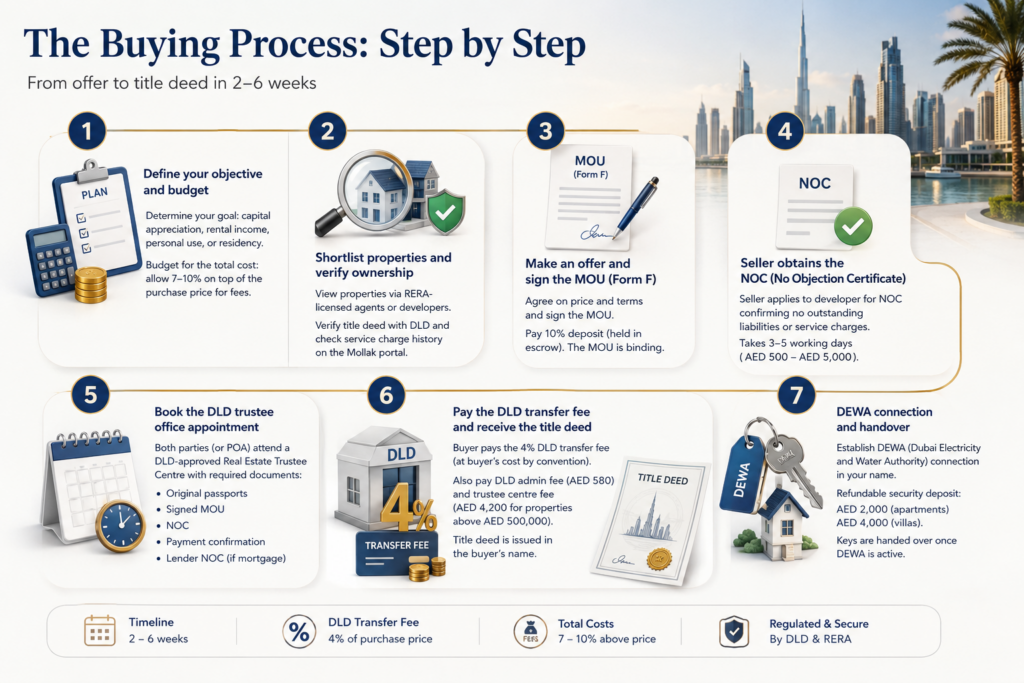
The Buying Process: Step by Step
For a ready (completed) secondary market property, the full process from agreed price to title deed typically takes two to six weeks. Off-plan purchases from developers follow a different process covered separately below.
Define your objective and budget. Determine whether you are buying for capital appreciation, rental income, personal use, or UAE residency qualification. Your objective determines the right community, property type, and ownership structure. Budget for the total cost of purchase, not just the unit price: allow 7 to 10% on top of the purchase price for transaction fees.
Shortlist properties and verify ownership. View properties through RERA-licensed agents or direct from developers. Before making an offer, verify the title deed authenticity through the DLD and check the property’s service charge history through the Mollak portal. Confirm the seller is the registered owner and that no outstanding service charges exist.
Make an offer and sign the MOU (Form F). Once price is agreed, both parties sign a Memorandum of Understanding, also known as Form F from the DLD. The MOU sets out the agreed price, payment terms, completion date, and responsibilities of each party. A deposit of 10% of the purchase price is paid by the buyer at this stage, typically held by the agent or in escrow until transfer. The MOU is binding: if the buyer withdraws after signing, the deposit is usually forfeited. If the seller withdraws, the buyer is generally entitled to the deposit back, often with compensation.
Seller obtains the NOC (No Objection Certificate). The seller applies to the developer or master developer for an NOC confirming there are no outstanding service charges or liabilities on the property. NOC issuance takes three to five working days in most cases (some developers take longer) and costs AED 500 to AED 5,000 depending on the developer. The NOC is required before DLD will process the transfer.
Book the DLD trustee office appointment. Both buyer and seller (or their authorised Power of Attorney representatives) attend a DLD-approved Real Estate Trustee Centre. Required documents: original passports, signed MOU, NOC, and payment confirmation. If the buyer has a mortgage, the lender’s NOC is also required.
Pay the DLD transfer fee and receive the title deed. The buyer pays the 4% DLD transfer fee at the trustee office. By convention in Dubai’s market, the buyer pays the full 4% even though the law technically splits it 50/50 between buyer and seller. The DLD admin fee (AED 580) and trustee centre fee (AED 4,200 for properties above AED 500,000) are also paid at this stage. The title deed is issued in the buyer’s name, completing legal transfer of ownership.
DEWA connection and handover. Establish a DEWA (Dubai Electricity and Water Authority) connection in your name. A refundable security deposit of AED 2,000 (apartments) or AED 4,000 (villas) is required. Keys are formally handed over once DEWA is active.
Every Fee You Will Pay: The True Cost of Buying
The advertised property price is not the total you will pay. Dubai’s buying costs are front-loaded and legally fixed. Unlike many markets, there are no ongoing annual property taxes after purchase. Budget for the following at the time of purchase:
| Fee | Amount | Notes |
| DLD transfer fee | 4% of purchase price | Paid at trustee office on transfer. By convention paid in full by buyer. |
| DLD admin fee | AED 580 | Fixed fee payable at DLD |
| Trustee Centre fee | AED 2,100 (under AED 500K) / AED 4,200 (above AED 500K) | Includes 5% VAT |
| Title deed issuance fee | AED 580 | Paid to DLD |
| NOC fee | AED 500 to AED 5,000 | Paid by seller in most MOUs. Developer-specific. |
| Agency commission | 2% of purchase price | If using a broker. Not payable when buying direct from developer. |
| Mortgage registration fee (if mortgaged) | 0.25% of loan amount + AED 290 | Payable at DLD if financing with a mortgage |
| DEWA connection deposit | AED 2,000 (apt) / AED 4,000 (villa) | Refundable on departure |
| Home insurance (if mortgaged) | AED 1,500 to 4,000/year | Required by bank |
| Total transaction costs (cash purchase) | Approx. 6 to 7% of purchase price | Excluding agency fee |
| Total transaction costs (mortgaged) | Approx. 7 to 10% of purchase price | Including mortgage registration |
For a worked example of total day-one cash on a specific purchase price, the complete cost of buying property in Dubai guide shows every line item including mortgage scenarios at AED 1.5M and AED 2M purchase prices.
Documents Required to Buy Property in Dubai as a Foreigner
The documentation requirements are minimal for foreign buyers compared to most international markets. There are no country-specific restrictions, no requirements for income proof as a buyer (though lenders require this for mortgages), and no requirement to open a UAE bank account before purchase.
For cash buyers
Valid passport (original required at the DLD trustee office)
Signed MOU (Form F)
Proof of funds (bank statement confirming available funds, required by some sellers and agents)
NOC from developer (arranged by seller)
For mortgage buyers (additional documents)
Bank pre-approval or offer letter
Bank NOC confirming no objection to the transfer
Property valuation report (commissioned by the bank)
Salary certificate or income proof (for the mortgage application)
For buyers using Power of Attorney (buying remotely)
Foreign buyers can complete a Dubai property purchase without being present in the country. The buyer appoints a representative through a UAE Power of Attorney (POA), which must be notarised in the buyer’s home country, apostilled, and then attested by the UAE Ministry of Foreign Affairs (MOFA). The POA holder can sign all documents and attend the DLD transfer on the buyer’s behalf.
Remote buying note: Most stages of the purchase can be completed remotely: shortlisting, negotiation, MOU signing, and mortgage application. The only step that typically requires physical presence in Dubai is the DLD trustee office appointment, and even this can be delegated to a POA holder. Many international buyers from the UK, India, and Europe complete the full process without visiting Dubai until after the title deed is issued.
Off-Plan vs Ready Property: Which Should You Buy as a Foreigner?
Foreign buyers have access to both off-plan (new developments from developers) and ready (completed secondary market) properties. The right choice depends on your timeline, cash flow requirements, and investment objectives.
| Factor | Off-Plan (from developer) | Ready / Secondary Market |
| Entry price | 10 to 20% below comparable ready values at launch | At current market price |
| Payment | Structured instalments over 2 to 5 years (no interest) | Full payment or mortgage at purchase |
| Rental income | None until handover | From day one |
| Appreciation potential | Launch-to-handover gain (10 to 30%+ in strong markets) | Standard market appreciation from purchase date |
| Buyer fund protection | RERA escrow law protects all payments | Standard MOU deposit protections |
| Timeline to ownership | 2 to 5 years (construction period) | 2 to 6 weeks |
| Agency fee | None when buying direct from developer | 2% if using an agent |
For the full guide to how off-plan works in Dubai, including payment plan structures, RERA escrow protection, snagging, and resale before handover, the off-plan property Dubai guide covers every step of the process.
Can Foreigners Get a Mortgage in Dubai?
Yes. Both UAE resident expats and non-resident foreign buyers can access mortgage financing in Dubai, though the terms differ between the two tracks.
| Factor | UAE Resident Expat | Non-Resident Foreigner |
| Max LTV (1st property under AED 5M) | Up to 80% | 60 to 65% |
| Min down payment | 20% | 35 to 40% |
| Fixed rates from | 3.49% p.a. | 5.25% p.a. |
| Min monthly income | AED 10,000 to 15,000 | Equiv. AED 15,000 in foreign currency |
| Bank options | All major UAE banks | Emirates NBD, HSBC, Mashreq, FAB, and others |
For the full mortgage guide including DBR limits, the 7x income cap, self-employed eligibility, and the step-by-step application process, the Dubai mortgage for expats guide covers every aspect in detail.
Taxes on Dubai Property: What Foreigners Actually Pay
Dubai’s tax environment for foreign property owners is one of the most favourable of any major global market. Understanding what applies and what does not is essential for anyone comparing Dubai against other investment destinations.
No annual property tax: Unlike the UK (council tax), US (property tax), or most European markets (taxe fonciere, IMU, etc.), Dubai charges no annual property tax on residential ownership.
No capital gains tax: When you sell, 100% of the sale price is yours. There is no CGT in the UAE for individual property holders. A UK higher-rate taxpayer saving 28% CGT on a AED 700,000 gain retains an additional AED 196,000 compared to the same transaction in the UK.
No income tax on rental income: Rental income from Dubai property is not taxed in the UAE for individual owners. Zero personal income tax applies to all rental earnings.
No inheritance tax: Property passes to heirs without UAE inheritance tax. Foreign buyers should register a DIFC Will to ensure Dubai-registered assets transfer according to their wishes rather than UAE inheritance law defaults.
Ongoing costs that do apply: Service charges (regulated by RERA through the Mollak platform), DEWA utility bills, and home insurance (if mortgaged). These are operating costs, not taxes.
Corporate tax note: Individual property holders pay no tax on rental income. Investors holding Dubai property through a UAE corporate entity face 9% corporate tax on net rental income above AED 375,000 per year under the 2023 corporate tax framework.
| Market | Gross Yield | Income Tax | CGT | After-Tax Net (approx.) |
| Dubai | 6 to 8% | 0% | 0% | 5 to 6.5% (all retained) |
| London | 2.5 to 4% | 20 to 40% | 18 to 28% | 1.2 to 2.4% |
| New York | 3 to 5% | 22 to 37%+ | 15 to 24% | 1.4 to 2.7% |
| Singapore | 2 to 3% | 17% | 0% | 1.2 to 2% |
Visa and Residency: What Property Ownership Unlocks
Buying property in Dubai does not automatically give you UAE residency. However, owning Dubai property above certain value thresholds qualifies you to apply for residency visas. Three tiers are available:
1. Golden Visa (10 years, AED 2M+)
The UAE Golden Visa is a 10-year renewable residency permit for property investors with DLD-certified property value of AED 2 million or above. Since February 2026, mortgaged properties qualify based on DLD valuation alone, without requiring a minimum paid equity amount. The visa covers the investor, spouse, children of any age (daughters) or under 25 (sons), parents, and domestic workers. No employer sponsor required. No minimum UAE stay requirement.
2. 2-Year Investor Visa (no minimum value since April 2026)
Since April 2026, the minimum property value requirement for the 2-year investor visa was removed. Any freehold property purchase now qualifies for a 2-year renewable residency visa, renewable indefinitely while the property is held. This is a significant change that makes UAE residency accessible at any budget. The 2-year visa has limited family sponsorship compared to the Golden Visa.
3. Retirement Visa (5 years, AED 1M+ for applicants aged 55+)
Foreign nationals aged 55 or above with a minimum of 15 years of work history can apply for a 5-year renewable retirement visa through the property route using a completed freehold property valued at AED 1 million or more. For the full guide to the retirement visa including the combination route and the rental income strategy, the retire in Dubai property guide covers the complete picture.
Key Considerations for Foreign Buyers in 2026
Home country tax obligations
The UAE does not tax your Dubai rental income or capital gains. Your home country may. UK residents must declare rental income from overseas property to HMRC. US citizens must declare worldwide income including UAE rental earnings to the IRS. Indian nationals must consider FEMA and LRS regulations when remitting funds. Consult a tax adviser in your home country before purchase. Dubai’s zero-tax environment improves your net return but does not necessarily eliminate home-country tax obligations depending on your personal circumstances.
Currency risk
The UAE dirham is pegged to the US dollar at a fixed rate of approximately 3.67. For USD-denominated investors, there is no currency risk on returns. For GBP, EUR, and INR investors, AED-denominated rental income and sale proceeds will fluctuate in home-currency terms with exchange rate movements, regardless of how the property performs in AED.
DIFC Will for inheritance planning
Without a registered DIFC Will, Dubai-registered assets of a foreign national who dies intestate may be distributed according to UAE Sharia inheritance law rather than the buyer’s home-country wishes. The DIFC Wills Service Centre allows non-Muslim foreigners to register a will governed by English law for Dubai-registered property. Registration costs approximately AED 10,000 and is strongly recommended for all foreign property buyers.
Service charge verification
Annual service charges are paid by the owner and regulated by RERA through the Mollak platform. They vary significantly by building and community, from AED 8 to 12 per sqft in affordable areas to AED 25 to 35 per sqft in premium buildings. Always verify the specific building’s registered service charge rate before purchasing. The difference can amount to AED 10,000 to 20,000+ per year on a 1,000 sqft unit and has a material impact on net rental yield.
Buying Dubai Property Remotely: How It Works
Dubai is one of the most remote-purchase-friendly real estate markets in the world. A significant proportion of international buyers complete the full process without visiting Dubai.
Property search: Conducted online through portal listings, developer websites, or virtual viewings. Many developers provide 3D tours and video walkthroughs.
Offer and MOU: Can be signed electronically or via courier for out-of-country buyers.
Payment: International bank transfers are accepted. Ensure your bank is notified of the large overseas transfer in advance to avoid delays.
DLD transfer: The one step most commonly requiring physical presence or a POA. A UAE-notarised Power of Attorney allows a representative to sign and attend on your behalf.
Mortgage (if applicable): Applications can begin remotely but banks typically require at least one in-person meeting for non-residents.
Practical tip: Buying off-plan direct from a DLD-registered developer like Januss is the most straightforward remote purchase route. The full reservation, SPA signing, and payment schedule can be handled digitally. The developer manages Oqood registration. No trustee office appointment is required until handover. See Januss current projects for current availability.
FAQ: Buying Property in Dubai as a Foreigner
Can any foreigner buy property in Dubai?
Yes. There are no nationality restrictions. Buyers from all countries can purchase freehold property in Dubai’s designated zones. The minimum buyer age is 21 years. No UAE visa, residency, or local sponsor is required. A valid passport is the only mandatory identification document.
Do I need to be in Dubai to buy property there?
Not necessarily. Most stages of the purchase can be completed remotely. The DLD trustee office appointment (for ready property) is the step most commonly requiring physical presence, but this can be delegated to a Power of Attorney holder. Off-plan purchases from developers can be completed entirely remotely through to handover, with the POA managing the final DLD transfer.
How much does it cost to buy property in Dubai as a foreigner?
Budget approximately 6 to 7% of the purchase price in transaction fees for a cash purchase, or 7 to 10% for a mortgaged purchase. The main costs are the 4% DLD transfer fee, the trustee centre fee (AED 4,200 for properties above AED 500,000), agency commission (2% if using a broker), and for mortgaged buyers, the mortgage registration fee (0.25% of loan amount plus AED 290).
What is the difference between freehold and leasehold in Dubai?
Freehold ownership gives you full title to the property and the land, with no expiry date and no restriction on selling, leasing, or passing to heirs. Leasehold gives you a long-term right to use the property (up to 99 years) without owning the underlying land. For investment and residency qualification purposes, freehold in a designated zone is the relevant structure. All major investment communities in Dubai (Marina, Downtown, JVC, Al Furjan, Dubai Hills, Palm Jumeirah) are freehold.
Does buying property in Dubai give me residency?
Not automatically, but property ownership above certain thresholds qualifies you to apply for residency visas. Since April 2026, any freehold property purchase qualifies for a 2-year investor visa (with no minimum value). The 10-year Golden Visa requires AED 2M in DLD-certified property value. The 5-year retirement visa requires AED 1M in completed freehold property for applicants aged 55 and above.
Can I get a mortgage in Dubai as a non-resident foreigner?
Yes. Select UAE banks including Emirates NBD, HSBC, Mashreq, and FAB offer non-resident mortgage products at 60 to 65% LTV, requiring a 35 to 40% down payment. Rates start from approximately 5.25% for non-residents. The application requires an equivalent of AED 15,000 per month in foreign currency income, international bank statements, and income tax returns.
Is there tax on property in Dubai for foreigners?
No annual property tax, no capital gains tax, and no income tax on rental income for individual property holders. The costs of ownership are the one-time purchase transaction fees (front-loaded), annual service charges, and utility bills. Your home country may still require you to declare overseas income or gains depending on your personal tax residency status.
What happens to my Dubai property when I die?
Without a registered DIFC Will, Dubai-registered property of a deceased non-Muslim foreigner may be distributed under UAE Sharia inheritance law regardless of the owner’s nationality. Registering a DIFC Will (approximately AED 10,000) allows non-Muslims to specify that their Dubai property passes according to their home-country wishes. This is strongly recommended for all foreign property buyers.
Explore Dubai Property as an International Buyer
For foreign buyers evaluating Dubai property, buying directly from a DLD-registered developer removes the agency commission (typically 2% of the purchase price) and gives you access to launch pricing before the secondary market. Januss Developers’ current off-plan projects in Al Furjan sit in one of Dubai’s strongest mid-market yield communities with direct metro access and units accessible at or above the Golden Visa AED 2M threshold. Browse current projects or speak with the Januss team to discuss how the buying process works for your specific situation.