

Quick Answer: Off-plan property means buying a unit directly from a developer before construction is complete, at launch pricing that typically sits 10 to 20% below comparable ready property values. You pay in structured instalments tied to construction milestones or a fixed schedule rather than in full upfront. In Dubai, all off-plan buyer payments are legally protected in government-supervised RERA escrow accounts and released to the developer only as construction milestones are verified. Off-plan accounted for approximately 65 to 70% of all Dubai residential transactions in 2025. The main risks are construction delays, market conditions at handover, and developer reliability, all of which are meaningfully reduced by RERA regulation but not eliminated.
Off-plan property dominates the Dubai market for a reason: launch pricing below ready market values, flexible payment plans that spread capital over years rather than requiring full upfront payment, and RERA’s legally mandated escrow protection that ring-fences your funds until construction milestones are confirmed. These three advantages together create a financing and risk profile that differs materially from most global off-plan markets.
This guide covers every aspect of off-plan buying in Dubai from a developer’s perspective: how payment plans actually work, what RERA escrow protects and what it does not, how to verify a developer before signing anything, what to check at handover, and an honest assessment of the risks. It is written for first-time off-plan buyers and experienced investors entering Dubai for the first time.
Januss note: As a DLD-registered developer in Al Furjan, we have direct experience of every stage of this process from the developer side. The detail below reflects how the system actually works, including the limitations that some guides soften.
What Is Off-Plan Property and How Does It Work?
Off-plan property is real estate purchased directly from a developer before the construction is complete. In some cases, buyers commit at the planning or permit stage before ground has been broken. In others, they buy mid-construction with 12 to 18 months remaining. The defining characteristic is that you are buying a future asset, not a completed one, based on architectural plans, developer renders, and a model unit or showroom.
The purchase works in stages:
Booking fee: Typically 5 to 10% of the purchase price, paid to reserve the specific unit. This is the first binding financial commitment.
Sales Purchase Agreement (SPA): The legally binding contract signed within days of the booking. Sets out the unit details, total price, payment schedule, completion timeline, and penalties for delays.
Oqood registration: The off-plan transaction is registered with RERA through the Oqood system. This gives the buyer a formal, DLD-recorded proof of ownership before the title deed exists. Oqood registration fee is approximately 4% of the purchase price or AED 3,000 to 4,000.
Payment instalments: Paid according to the agreed schedule, either tied to construction milestones or at fixed calendar intervals. Each payment goes into the project’s RERA escrow account.
Snagging: Pre-handover inspection where the buyer (or their appointed snagging company) checks the completed unit against the SPA specifications and identifies defects before final payment.
Handover: Final payment made, keys received, DEWA connection established, and the title deed (Tabu) issued by DLD.
Off-Plan vs Ready Property: Which Is Right for You?
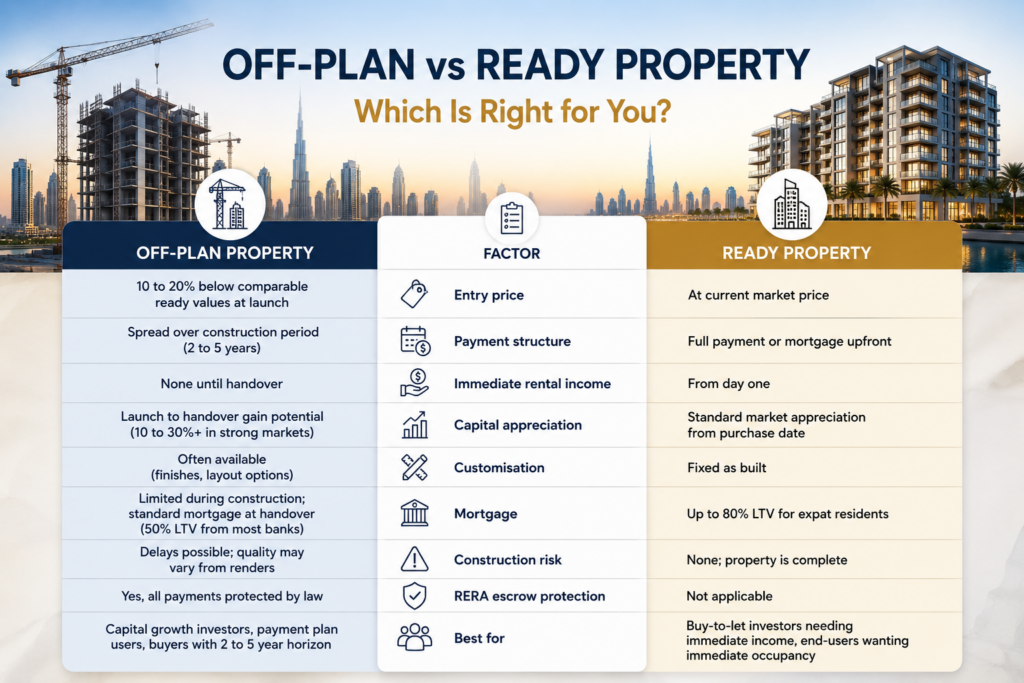
The decision between off-plan and ready property is not about which is objectively better. It is about which serves your specific timeline, capital position, and investment objective.
| Factor | Off-Plan | Ready Property |
| Entry price | 10 to 20% below comparable ready values at launch | At current market price |
| Payment structure | Spread over construction period (2 to 5 years) | Full payment or mortgage upfront |
| Immediate rental income | None until handover | From day one |
| Capital appreciation | Launch to handover gain potential (10 to 30%+ in strong markets) | Standard market appreciation from purchase date |
| Customisation | Often available (finishes, layout options) | Fixed as built |
| Mortgage | Limited during construction; standard mortgage at handover (50% LTV from most banks) | Up to 80% LTV for expat residents |
| Construction risk | Delays possible; quality may vary from renders | None; property is complete |
| RERA escrow protection | Yes, all payments protected by law | Not applicable |
| Best for | Capital growth investors, payment plan users, buyers with 2 to 5 year horizon | Buy-to-let investors needing immediate income, end-users wanting immediate occupancy |
Payment Plan Structures: What They Mean and How to Choose
Payment plans are one of the primary reasons investors choose off-plan over ready property. They spread capital over years, reduce upfront cost, and in post-handover structures, can allow you to use rental income to fund remaining instalments. Understanding the different plan types helps you select the one that matches your financial position.
Milestone-based plans
Payments are tied to verified construction milestones: foundation completion, structural frame, exterior, fit-out, and handover. Each tranche is released from escrow to the developer only after the relevant milestone is independently confirmed. The advantage is that payment directly tracks construction progress. You never pay ahead of where the building actually is.
Fixed-schedule plans (40/60, 50/50, 60/40)
The most common structure. A percentage is paid during construction (on a fixed calendar or milestone-linked schedule) and the balance is paid at handover. A 40/60 plan means 40% paid during construction, 60% at handover. A 60/40 plan means 60% during construction, 40% at handover. The split determines how much capital you deploy before the asset generates income.
Post-handover payment plans
Some developers offer plans that extend payments beyond the completion date. You take possession of the unit at handover with 30 to 50% still outstanding, paid in instalments over 1 to 3 years after handover. This allows the investor to rent the unit from day one and use rental income to fund the remaining instalments. Post-handover plans are popular with buy-to-let investors but are not universally available and tend to carry slightly higher unit pricing to compensate the developer for the extended credit.
1% monthly plans
An increasingly popular structure where the buyer pays 1% of the property value each month throughout the construction period. On a AED 1.2M unit, that is AED 12,000 per month for 2 to 3 years. The structure is predictable and easy to budget, though the total paid during construction can exceed equivalent milestone-based plans depending on tenure.
Which payment plan suits your profile
| Your situation | Best plan type | Reason |
| Want to rent out from day one | Post-handover | Take possession at handover with balance outstanding; fund from rent |
| Want to minimise upfront capital | 40/60 or post-handover | Lowest proportion paid before completion |
| Want maximum transparency of build progress | Milestone-based | Each payment linked to independently verified construction stage |
| Want predictable monthly cash flow | 1% monthly | Fixed amount each month regardless of milestone timing |
| Planning to mortgage at handover | 60/40 or 70/30 | Higher paid-in means lower mortgage required at handover; better LTV position |
How Your Money Is Protected: RERA Escrow Explained
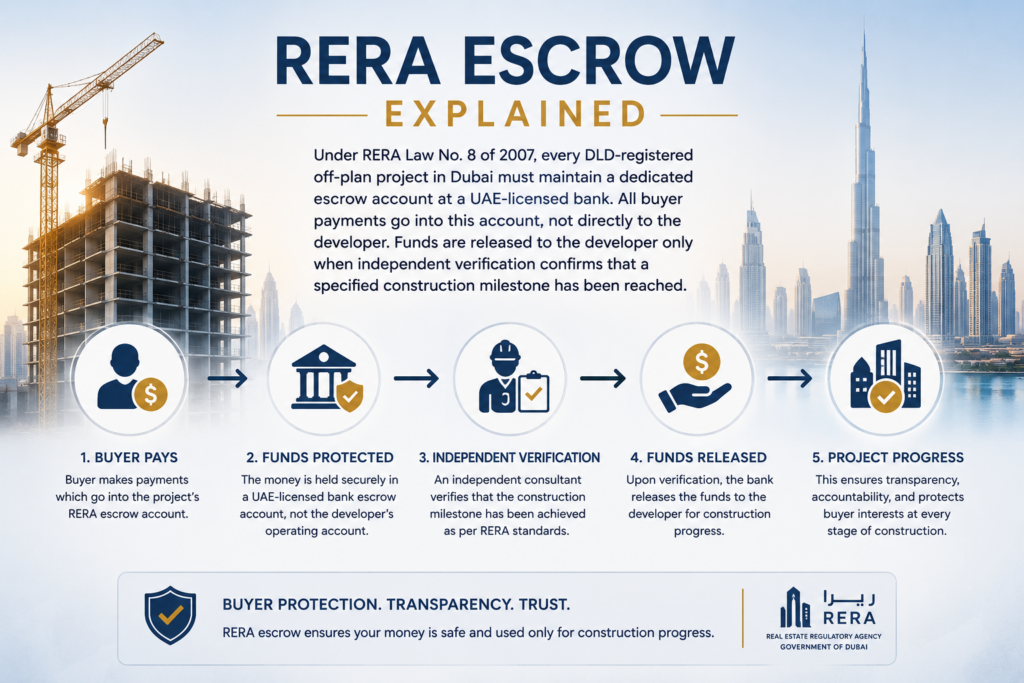
Under RERA Law No. 8 of 2007, every DLD-registered off-plan project in Dubai must maintain a dedicated escrow account at a UAE-licensed bank. All buyer payments go into this account, not directly to the developer. Funds are released to the developer only when independent verification confirms that a specified construction milestone has been reached.
What escrow protects against
Developer misuse of funds: Developers cannot draw down buyer payments for non-project expenses. The escrow bank is the gatekeeper.
Project cancellation by the developer: If a project is cancelled, buyers are entitled to refunds from the escrow account.
Developer insolvency mid-construction: Buyer funds held in escrow are ring-fenced from the developer’s general creditors in most insolvency scenarios.
What escrow does NOT protect against
Important: Most guides say ‘escrow protects buyers’ without explaining where the protection ends. This matters. Understanding the limits is part of proper due diligence.
Construction delays: Escrow does not prevent delays. A developer can be 12 months behind schedule and your funds remain in escrow, protected but not earning return. The SPA will specify delay penalties but enforcement varies.
Build quality variance: Escrow does not guarantee the finished unit matches the renders or SPA specifications exactly. This is managed through the snagging process.
Market risk at handover: If the market corrects between your purchase date and handover, escrow does not protect against a property value below your purchase price at completion. This is the risk that due diligence and area selection are designed to manage.
Developer delays beyond contractual penalties: If a developer repeatedly delays and the SPA penalty clauses are weak, escrow does not automatically compensate for lost time beyond those stated terms.
The Step-by-Step Off-Plan Buying Process
Research and shortlist. Identify communities with strong rental demand, infrastructure, and developer track records. Do not shortlist based on launch marketing alone. Check DLD transaction history for the community and developer.
Verify RERA registration. Every legitimate off-plan project has a RERA number. Verify this through the Dubai REST app or the DLD website before paying anything. An unregistered project has no escrow account and no buyer protection.
Verify the escrow account. Confirm the project has an active, DLD-registered escrow account at a UAE-licensed bank. This is separate from RERA registration verification. Ask the developer or agent to confirm the escrow bank in writing.
Pay the booking fee. Typically 5 to 10% to reserve the unit. Ensure the payment goes to the escrow account, not to a developer or agent’s operational account.
Review and sign the SPA. Read the full Sales Purchase Agreement before signing. Key sections: payment milestone schedule, completion date and penalty clause for delays, specifications and finish standards, defect liability period (typically 1 year), and assignment/resale conditions.
Oqood registration. The developer registers the SPA with RERA through the Oqood system. You receive an Oqood certificate confirming your off-plan ownership is officially recorded with DLD. This is your legal proof of purchase before the title deed exists.
Follow the payment schedule. Make each instalment according to the agreed schedule. Keep records of every payment and ensure each goes to the registered escrow account.
Track construction progress. Monitor the DLD’s developer progress reports. Some developers provide regular construction updates; others require you to check the Dubai REST app. Flag any significant delays to the developer in writing early.
Snagging inspection before final payment. Before making the final payment and taking keys, commission an independent snagging inspection. A RERA-licensed snagging company will assess the unit against the SPA specifications and produce a defect list. The developer is obligated to rectify defects before handover or after handover within the defect liability period.
Handover and title deed. Make the final payment, sign handover documents, receive keys, activate DEWA connection, and receive the title deed from DLD. The property is now yours with full registered ownership.
Total Cost of an Off-Plan Purchase: Every Fee
The advertised unit price is not the total you will pay. Several fees are fixed by law and must be budgeted for at the time of purchase or at handover.
| Fee | Amount | When Paid |
| Booking fee | 5 to 10% of purchase price | At reservation |
| Oqood registration (DLD off-plan registration) | 4% of purchase price or AED 3,000 to 4,000 | At SPA signing |
| DLD transfer fee (at handover/title deed) | 4% of purchase price | At handover |
| Real Estate Trustee Centre fee | AED 4,000 to 4,340 | At DLD transfer |
| Agency commission (if using broker) | 2% of purchase price | At SPA signing |
| DEWA connection deposit | AED 2,000 (apartment) | At handover |
| Service charge deposit | Varies by building | At handover |
| Home insurance (required by bank if mortgaged) | AED 1,500 to 4,000/year | At handover |
| Total additional costs (approx.) | 8 to 10% of purchase price | Across purchase and handover |
Januss note: When buying direct from Januss Developers, no agency commission is charged. On a AED 1.2M unit, that is a AED 24,000 saving. The 4% DLD fee applies regardless of whether you use an agent or buy direct from the developer.
Developer Due Diligence: What to Verify Before Signing
The quality of a Dubai off-plan investment depends heavily on developer selection. RERA regulation reduces risk significantly, but it does not make all developers equivalent.
RERA registration status: Verify the developer’s RERA registration number through the Dubai REST app or dubailand.gov.ae. A valid registration means the developer meets the baseline regulatory requirements.
Delivery track record: Ask how many projects the developer has completed, whether they were delivered on schedule, and what the post-handover feedback was. Search the developer name alongside ‘handover’ and ‘delay’ online before committing.
Active escrow account: Confirm the specific project has a registered DLD escrow account before paying anything. Ask for the escrow bank name and account confirmation in writing.
RERA project registration: The project itself must be registered with RERA. Check via the Dubai REST app using the project name or developer. An unregistered project is not covered by escrow law regardless of the developer’s overall registration status.
Financial standing: For large or long-duration projects, a developer’s financial capacity to complete matters. Publicly listed developers (Emaar, DAMAC, Aldar) provide financial disclosure. For private developers, ask about construction financing and project progress funding.
SPA delay penalty clause: Review what penalty applies if the developer delivers late. A meaningful penalty clause (AED per day of delay or percentage of purchase price per month) gives more protection than a generic ‘best efforts’ commitment.
The Handover Process and Snagging
Snagging is the pre-handover inspection process that buyers are entitled to conduct before making their final payment. It is one of the most underused buyer rights in the Dubai off-plan market.
What snagging covers
Finish quality against SPA specifications: paint, flooring, tiling, joinery, fixtures
Structural and waterproofing defects: cracks, water ingress, drainage
MEP (mechanical, electrical, plumbing) systems: AC, electrical sockets, water pressure, drainage
Windows and doors: sealing, operation, alignment
Kitchen and bathroom fittings: appliances, taps, showers
Common area access: car park space, lobby, lifts, amenities as specified
How to approach snagging
Commission a RERA-licensed snagging company to conduct the inspection before final payment. The snagging report documents every defect with photographs and specifications. Present this to the developer in writing. The developer must either rectify before you make final payment or confirm in writing that rectification will occur within the defect liability period (typically 1 year after handover). Do not make your final payment without completing this step.
Practical tip: Budget AED 1,500 to 3,500 for a professional snagging inspection. The cost is trivial relative to the protection it provides. A well-documented snag list is also useful if disputes arise later.
Resale Before Handover: Assignment of Contract
Off-plan investors are not locked in until handover. Most Dubai developers permit resale of the purchase agreement before the property is complete, provided certain conditions are met.
Minimum paid threshold: Most developers require between 30 and 40% of the purchase price to be paid before approving an assignment. Some require 50%.
Assignment fee: The developer typically charges an assignment fee of AED 5,000 to 10,000 or a percentage of the sale price.
DLD NOC: The buyer of the assignment receives a No Objection Certificate from DLD to transfer the purchase agreement.
New buyer takes on the remaining payment schedule: The new buyer assumes both your paid history and the remaining instalments according to the original SPA.
Assignment allows investors to realise appreciation gains before handover without waiting for the full construction period. In strong market conditions, off-plan units are frequently resold mid-construction at a premium above the original purchase price. In weaker conditions, assignment at or near original purchase price may be the realistic exit.
Off-Plan Mortgages: What Banks Will and Won’t Lend
Mortgage financing for off-plan properties works differently from ready property and is a source of confusion for buyers.
During construction
Banks rarely lend against an off-plan property during the construction period. The asset does not yet exist as a completed structure and cannot serve as mortgage collateral in the standard sense. Some banks offer construction finance facilities to developers, but this is not buyer financing. Most off-plan purchases during the construction phase are cash purchases funded by the payment plan.
At handover: mortgage on the completed property
When the property completes and the title deed is issued, standard mortgage financing becomes available. For expat residents, LTV up to 80% on a first property under AED 5M. For non-residents, 60 to 65% LTV. The mortgage is secured against the completed, title-deed-registered property.
Planning point: If you are funding your off-plan purchase through a payment plan and plan to refinance with a mortgage at handover, verify your eligibility for that mortgage well in advance of the handover date. Changes in income, credit position, or DBR between purchase and handover can affect mortgage eligibility. Budget for the possibility of funding the handover balance from personal resources if mortgage approval is delayed.
For a full guide to expat mortgage eligibility, rates, and the step-by-step application process, the Dubai mortgage for expats guide covers every aspect including the DBR calculation and 7x income cap.
Best Areas for Off-Plan in Dubai 2026
Off-plan is available across virtually every Dubai community, but the investment case varies significantly. For the full area-by-area analysis of yield, appreciation, and supply risk, the best areas to invest in Dubai 2026 guide covers every major community. For off-plan specifically:
Al Furjan: Mid-market freehold community with metro access. Off-plan units at launch pricing 10 to 15% below comparable ready property. Januss Developers is based here. Strong yield fundamentals with 7 to 9% gross on completed units.
JVC: Largest off-plan market outside of master developer communities. Wide developer choice. Strong yield but check supply pipeline in specific sub-zones before committing.
Dubai Hills Estate: Emaar master community with strong family demand. Off-plan launches are periodic and sell quickly. Balanced yield and appreciation profile.
Dubai Creek Harbour: Emaar-backed waterfront master community. Off-plan from the master developer with established infrastructure. Lower risk than peripheral emerging areas.
Dubai South: Airport city with long-horizon growth thesis. Off-plan at very affordable entry prices. Suited to investors with 7 to 10 year minimum hold period.
The Investment Case: When Off-Plan Beats Ready
Off-plan is not automatically the better investment. It is the better choice under specific conditions that the investor should be able to identify clearly before committing.
When off-plan outperforms ready
You are buying in a community with strong fundamentals where launch pricing is genuinely 10 to 15% below secondary market values
Your investment horizon extends at least 2 to 3 years beyond the expected handover date
You want to maximise capital deployed over time rather than upfront (payment plan advantage)
The developer has a proven delivery track record in the same or comparable communities
You are comfortable accepting the construction timeline risk in exchange for the entry price advantage
The flat-market floor test
Before committing to any off-plan purchase, run this calculation: assume the property is worth exactly what you paid at handover. No appreciation whatsoever. Calculate the net rental yield on that assumption. If the yield at that level still justifies the investment, you have a fundamentals floor independent of market performance. If the investment only works with 15% appreciation by handover, it is a speculation, not an investment.
Investor tip: This test is the single most useful pre-purchase calculation for off-plan buyers. It separates speculative purchases from fundamentals-based investments. Apply it to every project you evaluate.
Risks: The Honest Assessment
Dubai’s off-plan market is among the best regulated globally. That does not make it risk-free.
Construction delays: The most common risk. RERA data shows a meaningful proportion of Dubai off-plan projects deliver later than the SPA completion date. Penalty clauses provide some compensation but do not recover lost rental income during delay periods. Factor in a 6 to 12 month buffer when planning rental income timing.
Build quality variance: Renders and model units are marketing materials. The finished product may differ in material quality, finish level, or layout execution from what was shown. Snagging mitigates but does not eliminate this risk.
Market risk at handover: If market prices fall between your purchase date and handover, you may find yourself holding a property worth less than you paid. This is a real scenario in oversupplied communities. RERA escrow protects your money until you complete. It does not protect against market value decline.
Developer default or project cancellation: Rare for RERA-registered projects with active escrow accounts, but possible. If a project is cancelled, buyers receive escrow refunds. If a developer faces financial difficulty mid-construction and the project is restructured or handed to a different developer, outcomes vary. DLD has intervened in past cases to protect buyers.
Liquidity risk at handover: If you need to exit quickly at or shortly after handover, the secondary market for recently completed off-plan units can be soft when multiple units in the same development complete simultaneously. Factor in a minimum 12 month hold post-handover for realistic secondary market pricing.
Golden Visa and Off-Plan Property
Off-plan property can qualify for the UAE Golden Visa, the 10-year renewable residency permit, once two conditions are met: the total paid to date in instalments reaches AED 2 million, and the developer provides a written confirmation letter confirming the project’s Golden Visa eligibility. A full title deed is not required; the Oqood certificate and the amount paid are the qualifying evidence. For buyers purchasing off-plan at the AED 2M+ price point, Golden Visa eligibility is accessible part way through the construction period without waiting for handover.
FAQ: Off-Plan Property Dubai
What is off-plan property in Dubai?
Off-plan property is real estate purchased directly from a developer before construction is complete, based on plans and renders. Buyers pay in structured instalments over the construction period rather than upfront in full. Off-plan accounted for approximately 65 to 70% of all Dubai residential transactions in 2025.
Is off-plan property safe to buy in Dubai?
Safer than most global markets due to RERA Law No. 8 of 2007, which requires all buyer payments to be held in government-supervised escrow accounts and released to developers only upon verified construction milestones. The main risks that escrow does not protect against are construction delays, build quality variance, and market risk at handover. Buying from a RERA-registered developer with a proven delivery track record and verifying the escrow account before paying anything are the primary risk management steps.
What is a typical payment plan for off-plan property in Dubai?
The most common structure is a 40/60 or 60/40 split: a percentage paid in instalments during construction, the balance at handover. Post-handover plans extend payments 1 to 3 years beyond completion. 1% monthly plans are increasingly popular for predictable monthly budgeting. The booking fee is typically 5 to 10% and paid at reservation.
What is the difference between Oqood and a title deed?
Oqood is a provisional registration certificate issued by RERA when an off-plan SPA is registered with DLD. It is your legal proof of purchase and records your ownership in the RERA register before the property is built. The full freehold title deed is issued by DLD when construction is complete and the unit is formally transferred at handover. Both are legally significant ownership documents.
Can I sell an off-plan property before it is completed?
Yes, through an assignment of contract. Most developers permit resale after 30 to 40% of the purchase price has been paid. The developer charges an assignment fee and issues a No Objection Certificate for the transfer. The new buyer takes on the remaining payment schedule. Assignment allows investors to realise appreciation gains before handover without waiting for full construction completion.
Can I get a mortgage on off-plan property in Dubai?
During construction, banks generally do not lend against off-plan properties. The standard approach is to fund the construction phase through the payment plan, then take out a standard mortgage against the completed property at handover. At handover, expat residents can access up to 80% LTV on a first property under AED 5M. Non-residents can access 60 to 65% LTV. Plan for the possibility of funding the handover balance personally if mortgage approval is delayed.
What fees do I pay when buying off-plan in Dubai?
The main costs beyond the unit price: Oqood registration fee (4% of purchase price or AED 3,000 to 4,000), DLD transfer fee at handover (4%), Real Estate Trustee Centre fee (AED 4,000 to 4,340), agency commission if using a broker (2%), DEWA connection deposit (AED 2,000), and service charge deposit. Total additional costs are approximately 8 to 10% of the purchase price spread across purchase and handover.
How do I verify a Dubai developer before buying off-plan?
Check the developer’s RERA registration through the Dubai REST app. Verify the specific project has a registered DLD escrow account. Check the developer’s delivery track record for previous projects. Review the SPA delay penalty clause before signing. Ask for the escrow bank name and account confirmation in writing. All legitimate DLD-registered developers and projects are verifiable through the Dubai REST app.
Explore Off-Plan Projects in Al Furjan
Januss Developers is a DLD-registered developer with an active off-plan pipeline in Al Furjan, one of Dubai’s strongest mid-market yield communities with direct metro access. All Januss projects comply with RERA Law No. 8 of 2007 with buyer funds held in DLD-supervised escrow. Buying direct from Januss saves the 2% agency commission. Browse current projects or speak with the team about current availability, payment plan structures, and Golden Visa eligibility at each development.