
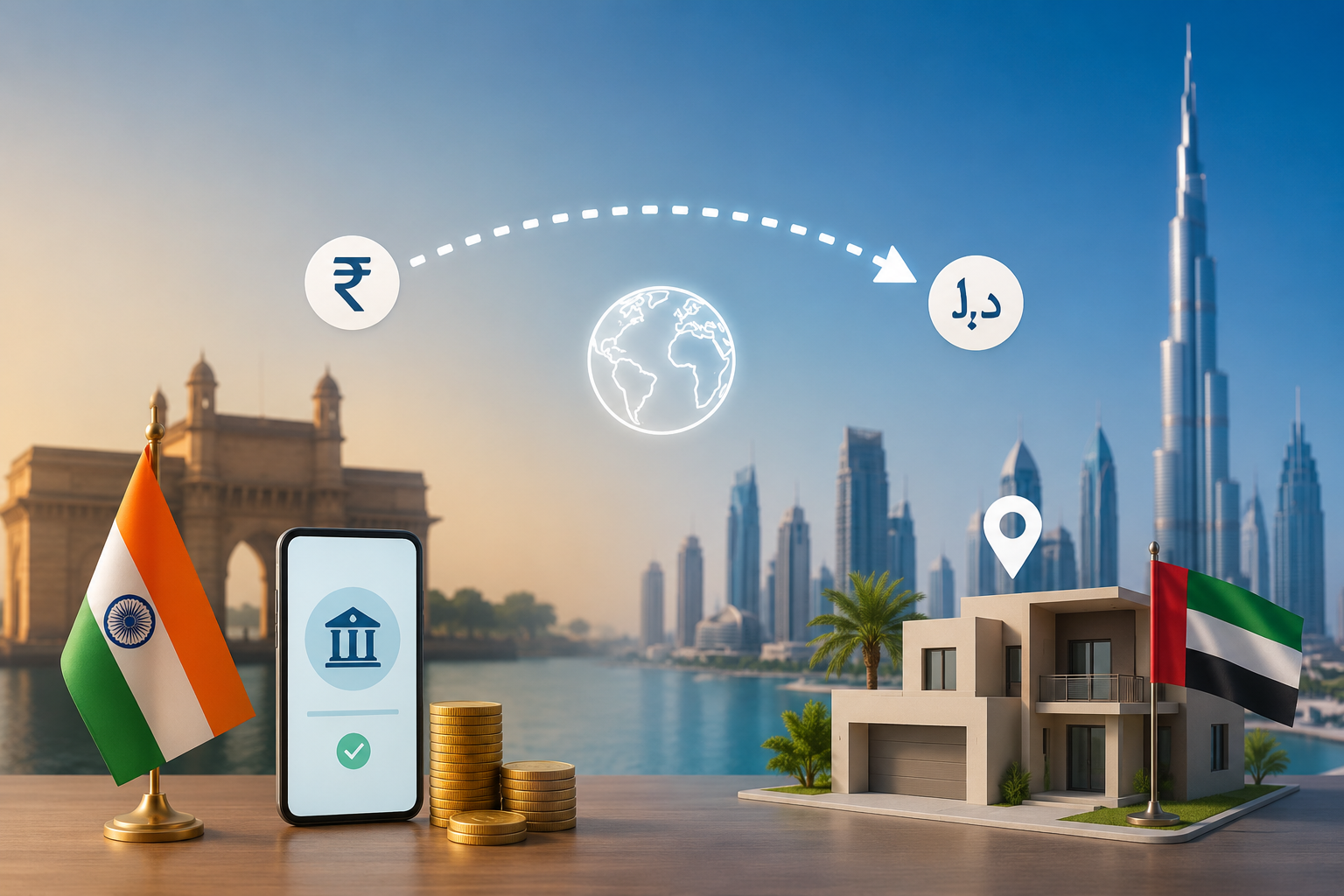
What does legally transferring money from India to Dubai for property actually involve? It means routing your funds through an RBI-authorised bank under the Liberalised Remittance Scheme (LRS), tagging the transfer with the correct purpose code, filing the right forms before the money leaves your account, and keeping a paper trail that protects you from any regulatory scrutiny on either side of the transaction. Done correctly, this is a standard, well-trodden process, not a grey area.
Most Indian buyers who stall before buying Dubai property aren’t uncertain about the investment. They’re uncertain about this step. The property makes sense. The process feels opaque. This guide is the process, in full, with nothing left out.
Before we go into the steps, one question that determines which path applies to you:
Are you a resident Indian, living and earning in India, or an NRI living and earning outside India?
The answer changes everything about how you transfer money. We’ll cover both.
First, Are You a Resident Indian or an NRI? Your Remittance Route Depends on This
This is the question most articles skip, lumping both buyer types under the same set of rules. They’re not the same.
| Resident Indian | NRI (Gulf/overseas income) | |
| Governed by LRS? | Yes | No |
| Annual remittance cap | USD 250,000 per person | No cap from overseas income |
| Forms required | Form A2, Form 15CA, Form 15CB | None (standard international wire) |
| Purpose code needed | S0005 | Not applicable for overseas account transfer |
| Account to use | Indian savings/current account | NRE, FCNR, or overseas bank account |
| TCS applicable? | Yes, above ₹7 lakh | No, for NRE/overseas transfers |
If you live in Dubai, Riyadh, London, or anywhere outside India and your income is earned there, the RBI’s LRS rules do not apply to you. Jump to the NRI section below. If you live in India and earn in rupees, the LRS route is your path, and steps 1 through 8 below are for you.
For Resident Indians, The LRS Route, Step by Step
The Liberalised Remittance Scheme is the RBI framework that allows Indian residents to send money abroad for permitted purposes, including the purchase of immovable property outside India. Here’s the exact process.
Step 1, Check your LRS headroom
The LRS limit is USD 250,000 per individual per financial year. The Indian financial year runs April 1 to March 31, not January to December. Your bank tracks cumulative LRS usage; ask them how much of your annual limit you’ve already used before initiating any transfer.
Step 2, Identify your Authorised Dealer (AD) bank
All LRS remittances must go through an RBI-licensed Authorised Dealer bank, which is any scheduled commercial bank in India. HDFC, ICICI, SBI, Axis, Kotak, HDFC Bank, Federal Bank all process LRS transfers. You cannot use a money transfer operator, currency exchange agent, or any informal channel. The AD bank is the only legal route.
Step 3, Prepare your documentation
Before visiting your bank or initiating the online transfer, have these ready:
- Valid Indian Passport
- PAN Card, mandatory for all overseas remittances
- Property booking agreement or signed SPA, this is your purpose evidence, confirming the transfer is for property purchase and not a general capital transfer
- Source of funds documentation, bank statements showing the funds are from declared income
Step 4, Fill Form A2
Form A2 is the RBI’s standard outward remittance declaration form. Your bank issues it, either at the branch or through their online portal for outward remittances. You declare: the amount, the recipient details, the purpose, and your confirmation of FEMA compliance. Keep a signed copy for your records. Many buyers have never heard of this form by name; ask for it explicitly.
Step 5, Enter purpose code S0005
This is the step that most articles skip entirely, and it’s the one that matters most operationally.
Purpose code S0005 is the RBI-designated code for “purchase of immovable property outside India.” Every LRS remittance for a Dubai property purchase must be tagged with this code. It appears as a field in Form A2 and in most banks’ online outward remittance portals. If your bank’s portal doesn’t show it or groups it under a general “capital account” category, go to the branch and specify S0005 explicitly.
Why this matters: if your transfer is coded incorrectly, say, under S0001 (maintenance of close relatives) or S0006 (gifts), it creates a compliance discrepancy between your stated purpose and the actual use of funds. That discrepancy can attract scrutiny. S0005 is correct, clean, and specific. Use it.
Step 6, Submit Form 15CA and Form 15CB
For remittances above ₹5 lakh, two additional forms are required before your bank will process the transfer.
Form 15CB is issued by a Chartered Accountant. Your CA certifies the nature of the payment, its taxability under Indian law, and whether DTAA provisions apply. Get this done first, banks won’t accept Form 15CA without it.
Form 15CA is your self-declaration, submitted online to the Income Tax portal. It references the Form 15CB certification. Once submitted, you get an acknowledgement number, provide this to your bank with the Form 15CB itself.
Budget 3-5 working days for a CA to prepare Form 15CB, and another 1-2 days for the Form 15CA upload and acknowledgement.
Step 7, Initiate the bank wire
Your bank processes the transfer to the DLD-regulated escrow account in Dubai. For off-plan purchases, the account details are on the Oqood registration certificate and the developer’s payment instructions. For ready property, the transfer goes through the Dubai Land Department process.
Critical: never transfer to a personal or third-party bank account. Every legitimate Dubai property transaction routes funds either through DLD escrow (off-plan) or the DLD transfer process (ready). If anyone asks for a personal account wire, stop the transaction.
Step 8, File and retain your documentation
Keep copies of: Form A2 with purpose code S0005, Form 15CA acknowledgement, Form 15CB from your CA, the SWIFT confirmation from your bank, and the developer’s escrow acknowledgement from Dubai. This is your compliance paper trail. Store it permanently, not just for this financial year.
Understanding TCS, It’s Not a Tax on Your Investment
This is the number that causes the most unnecessary anxiety among Indian buyers, and it deserves a clear explanation.
Since October 2023, outward remittances above ₹7 lakh per financial year attract 20% Tax Collected at Source (TCS). If you transfer ₹1 crore, your bank deducts ₹20 lakh and deposits it with the government before the remaining ₹80 lakh leaves India.
Here is what TCS is not: it is not an additional cost on your Dubai property purchase. It’s not a permanent tax.
Here is what TCS is: it’s an advance collection of income tax, the government collecting money from you now, on account, against your annual income tax liability. When you file your ITR for that financial year, the entire TCS amount appears as a tax credit. If your total income tax payable is ₹15 lakh and TCS of ₹20 lakh was collected, you get a ₹5 lakh refund.
The practical impact is cash-flow timing, not cost. Budget for the TCS deduction at the time of remittance, knowing you’ll recover it through your ITR. The worst case is a few months of capital being held. The best case is it offsets your entire income tax bill.
Planning note: if you remit early in the financial year, the TCS credit sits for longer before your ITR. Remitting in January to March means the ITR filing cycle (July filing for March year-end) is closer, and the credit turnaround is faster.
The Financial Year Calendar Strategy, Moving More Than USD 250,000 Legally
For properties priced above USD 250,000, which covers most quality mid-market Dubai apartments, resident Indian buyers need a plan. Here are the three legal strategies.
Strategy 1, Straddle the financial year
The LRS year resets on April 1. Clean. Complete. You can send USD 230,000 in February, and USD 230,000 in April, that’s USD 460,000 moved in two bank transfers, six weeks apart, fully within LRS rules. This is precisely why off-plan properties with construction-linked payment plans work so well for Indian resident buyers: the payment schedule naturally spreads across financial years, keeping each annual tranche within the LRS ceiling.
At Januss Developers, our payment plans for Minati Homes are structured with this remittance reality in mind, not just for our convenience, but because it’s how Indian buyers can legally and comfortably manage the payments.
Strategy 2, Co-ownership with family
Each individual has their own USD 250,000 annual LRS limit. If you and your spouse are both registered co-owners of the Dubai property, each of you can remit USD 250,000 per year, that’s USD 500,000 per year for two co-owners. Adding parents as co-owners (if their finances are clean and documented) increases the combined capacity further.
This is standard practice, not a loophole. It’s the architecture by which most Indian families buy properties in the USD 500,000 to 1 million range.
Strategy 3, UAE mortgage to reduce the India-side transfer
NRI buyers with UAE residency, and sometimes non-resident buyers with strong income documentation, can access UAE bank mortgages at 50-75% LTV. If you borrow AED 1 million from a UAE bank and remit AED 1 million from India, you’ve cut your India-side transfer requirement in half. Major UAE banks, Emirates NBD, ADCB, FAB, offer NRI and non-resident mortgage products. Interest rates are currently 4.5-5.5%.
For NRIs, Why Your Route Is Simpler
If you’re living outside India and your income is earned in a foreign currency, the LRS framework simply doesn’t apply to you.
The LRS is an RBI regulation governing Indian residents. The RBI has no jurisdiction over your AED salary in Dubai, your SAR income in Riyadh, or your USD earnings in New York. That income is already outside India’s regulatory perimeter.
How NRI purchases work:
- Fund the Dubai purchase directly from your NRE account, FCNR account, or overseas bank account
- Wire directly to the DLD escrow or developer account in Dubai, standard international bank transfer
- No Form A2, no Form 15CA/CB, no purpose code, no LRS forms
- No annual remittance cap, you can buy at any price point your finances support
NRE vs NRO, why it matters:
Your NRE account holds funds you’ve earned outside India, converted to rupees. These funds are freely repatriable, you can send them back overseas, including to your Dubai property purchase, without RBI approval. Rental income from your Dubai property deposited into your NRE account can be sent back to Dubai or anywhere else freely.
Your NRO account holds India-sourced income (Indian rent, Indian dividends, pension). NRO funds have a repatriation limit of USD 1 million per year and attract Indian tax. For Dubai property purchases, use NRE or your overseas account, not NRO.
What Not to Do, Unofficial Channels and the Real Risk
We’ll be direct: hawala networks, informal currency agents, and cryptocurrency are illegal for this purpose under FEMA.
The Enforcement Directorate investigates overseas property purchases where funds moved through unofficial channels. The buyers who’ve faced ED scrutiny in media reports were not using LRS, they were routing unaccounted funds through hawala or structuring transactions to avoid declaration. The consequence isn’t a fine. It’s property attachment, penalties up to three times the remitted amount, and potential criminal prosecution under FEMA 1999.
What makes you safe:
- Every rupee routed through an AD bank with purpose code S0005
- Form 15CA/CB filed and acknowledged before transfer
- Source of funds traceable to declared income in your ITR
- Developer is RERA-registered; payment goes to DLD escrow
All Januss Developers projects are RERA-registered and DLD-compliant. We don’t accept payments from unofficial sources, and our buyer transactions are processed through UAE AML-compliant banking channels. Buyers who follow this guide have a clean, documented paper trail on both sides of the transaction, and that is the best protection against any regulatory question.
Your Indian Tax Obligations After the Transfe
The remittance doesn’t end your India-side obligations. Two annual requirements that every Dubai property owner in India must meet:
Schedule FA, Foreign Asset Declaration
From the year you purchase Dubai property, you must declare it in Schedule FA (Foreign Assets) of your annual Indian Income Tax Return. This applies to resident Indians. It’s a disclosure, not a payment, but it’s mandatory. Non-declaration is a Black Money Act violation. Penalties start at ₹10 lakh per undisclosed asset and can escalate to criminal prosecution. This is one section of your ITR, prepared by your CA, filed annually. Do not skip it.
Schedule FSI, Foreign Source Income
If your Dubai property earns rental income, declare it in Schedule FSI (Foreign Source Income) in your ITR. Under the India-UAE Double Taxation Avoidance Agreement (DTAA), since Dubai charges zero income tax on rental income, the DTAA credit means your net Indian tax liability on Dubai rental income is minimal, but declaration is non-negotiable.
Both disclosures are straightforward with a FEMA-qualified CA. Budget for this as an annual compliance cost, not a burden, a good CA handles both in the normal course of your ITR filing.
Where Does the Money Go Once It Reaches Dubai?
For off-plan purchases from a RERA-registered developer, your transfer lands in a DLD-regulated escrow account. This is a government-supervised account that the developer can only draw from when independent construction milestones are certified by the Dubai Land Department. Your money sits in escrow, protected, until the project reaches the stage it was supposed to reach.
For ready property, the transfer forms part of the Dubai Land Department title transfer process, both parties transact at the DLD (or via Power of Attorney), and the Title Deed is issued only after payment is verified and the DLD fee is settled.
No legitimate Dubai property transaction requires you to wire money to a personal account. If anyone presents you with personal account details for a property payment, that’s fraud, report it to the DLD and stop the transaction.
Documents You Need Before Your Bank Will Process the Transfer
Gather these before you approach your AD bank. Missing any one of them will delay the transfer.
- Valid Indian Passport, identity verification for FEMA compliance
- PAN Card, mandatory for all overseas remittances; your bank will not process without it
- Property booking agreement or SPA, purpose evidence confirming the funds are for property purchase
- Form A2, issued at your bank; your outward remittance declaration
- Form 15CB, CA-certified tax certificate; must be prepared before Form 15CA is filed
- Form 15CA acknowledgement, uploaded to the Income Tax portal; acknowledgement number provided to your bank
- Bank KYC, some banks request recent bank statements and address proof for large outward transfers
- Developer’s escrow account details, the DLD-registered account in Dubai; Januss provides these in the booking documentation pack
Frequently Asked Questions
What is the maximum amount I can transfer from India to Dubai for property under LRS?
USD 250,000 per individual per financial year (April 1 to March 31). This limit applies to resident Indians, NRIs funding from overseas income are not subject to LRS. Families can increase the effective limit by registering multiple co-owners, each with their own USD 250,000 annual capacity. Off-plan payment plans timed across financial years allow higher-value purchases to stay within LRS rules.
What is purpose code S0005 and why does it matter?
Purpose code S0005 is the RBI-designated code for purchase of immovable property outside India. It must be entered in Form A2 and in your bank’s outward remittance portal when sending money for a Dubai property purchase. Using the wrong purpose code creates a compliance mismatch between your stated intention and the actual use of funds, which can attract regulatory scrutiny. Always specify S0005 explicitly when instructing your bank.
What is TCS on outward remittance and will I get it back?
TCS (Tax Collected at Source) at 20% applies to outward remittances above ₹7 lakh. It’s deducted by your bank at the time of transfer and deposited with the government as an advance against your income tax liability. It’s not a permanent cost, it’s a tax credit that you claim when filing your annual ITR. The full TCS amount offsets your income tax payable; if TCS exceeds your liability, you get a refund.
Can I use hawala or an informal agent to send money for Dubai property?
No, this is illegal under FEMA 1999 and is exactly what the Enforcement Directorate investigates. Penalties include fines up to three times the amount transferred, property attachment, and criminal charges. Every rupee for a Dubai property purchase must go through an RBI-licensed Authorised Dealer bank with purpose code S0005 and proper Form 15CA/CB documentation. There is no legitimate shortcut.
Do I need to declare my Dubai property in my Indian income tax return?
Yes, if you’re an Indian tax resident. Declare it in Schedule FA (Foreign Assets) every year from the year of purchase, non-declaration is a Black Money Act violation with penalties starting at ₹10 lakh. If the property earns rental income, declare it in Schedule FSI (Foreign Source Income). The India-UAE DTAA means the practical tax impact is minimal, but disclosure is mandatory regardless.
Can my spouse and I both remit separately to buy the same Dubai property?
Yes, if both of you are registered co-owners on the property. Each individual’s LRS limit is USD 250,000 per financial year. Two co-owners can remit a combined USD 500,000 per year. The co-ownership must be reflected in the Sale and Purchase Agreement and in the DLD registration. This is standard practice for Indian families purchasing higher-value Dubai units.
Ready to Move from Decision to Action?
The remittance process has moving parts, purpose codes, tax forms, financial year timing, TCS planning. It looks complicated in isolation. With the right support, most buyers complete their first transfer without a single rejected form.
We’ve walked Indian buyers through this process many times at Januss Developers, from the first LRS question to the DLD escrow confirmation. Our NRI investment team understands both sides of this transaction: the Dubai side and the India side. We work with FEMA-qualified CAs and AD bank-experienced advisors who can help you prepare your documentation, structure your payment tranches, and ensure every transfer is clean, documented, and fully compliant.
When you’re ready to move from decision to action, that’s where we start.