
Quick Answer: Yes, expats can get a mortgage in Dubai. UAE-resident expats access up to 80% LTV on a first property under AED 5 million, with fixed rates from 3.49% and a straightforward 4 to 6 week process. Non-residents can also borrow, but at 60 to 65% LTV with stricter documentation.
Two hard limits shape every Dubai mortgage: a 50% Debt Burden Ratio cap and a seven-times annual income financing ceiling. Both apply simultaneously, and the lower of the two is always binding.
Dubai’s mortgage market has matured significantly. Property Finder data shows mortgage-backed transactions grew 30% year-on-year in early 2026, and expats account for the majority of that volume.
UAE banks actively compete for resident expat mortgage business, and a number of lenders have dedicated products for non-resident buyers too.
The process is structured and governed by the UAE Central Bank, which means the rules are consistent and predictable. The challenge for most expat buyers is not the system itself but knowing in advance which constraints will be binding for their specific profile before they sit down with a lender.
That is what this guide covers: the real rules, both borrowing caps applied together, the true cash required on day one, and the cases where a developer payment plan is a smarter route than a bank mortgage.
Januss note: As a DLD-registered developer in Dubai’s freehold zones, we work with expat buyers at every stage of the purchase process. The information below reflects the rules as they stand in 2026.
Expat Resident vs Non-Resident: The Track That Determines Everything
The most important distinction in Dubai’s mortgage market is not nationality but residency status. The two tracks carry materially different LTV limits, documentation requirements, and rate tiers.
| Factor | Expat Resident (UAE visa holder) | Non-Resident (no UAE visa) |
| Max LTV (1st property, under AED 5M) | Up to 80% | 60% to 65% |
| Min down payment | 20% | 35% to 40% |
| Fixed rates from | 3.49% p.a. | 5.25% p.a. |
| Min monthly income | AED 10,000 to 15,000 | Equiv. AED 15,000 in foreign currency |
| Credit check | AECB (UAE credit bureau) | AECB + international credit report |
| Bank options | All major UAE banks | Select banks with non-resident products |
| Max tenure | 25 years (age 65 at end of term) | 25 years (some banks cap shorter) |
The Two Hard Limits That Decide How Much You Can Borrow
Dubai mortgage affordability is governed by two independent caps set by the Central Bank of the UAE (CBUAE). Both apply to every expat application and the lower of the two is always the binding constraint. Many buyers know about one of them; very few know both.
Limit 1: Debt Burden Ratio (DBR) cap of 50%
Your total monthly debt obligations, including the new mortgage instalment, cannot exceed 50% of your gross monthly income. Car loans, personal loans, and credit card minimum payments all count toward this total. Banks verify this through bank statements and a credit check with AECB.
Limit 2: Seven-times annual income financing cap
The CBUAE also caps the total mortgage amount at seven times annual gross income for expatriates (eight times for UAE nationals). This cap applies regardless of the DBR calculation. On a monthly income of AED 20,000 (AED 240,000 annually), the maximum loan is AED 1.68 million under this rule, even if your DBR calculation would allow more.
Worked example at three income levels: Both constraints calculated simultaneously. Assumes first property under AED 5M, 25-year term, 4.5% rate, no existing debt.
| Monthly income | DBR max monthly payment | DBR-implied loan (~25yr/4.5%) | 7x annual income cap | Binding limit | Notes |
| AED 15,000 | AED 7,500 | AED 1.17M | AED 1.26M | DBR | DBR is tighter |
| AED 20,000 | AED 10,000 | AED 1.56M | AED 1.68M | DBR | DBR is tighter |
| AED 40,000 | AED 20,000 | AED 3.12M | AED 3.36M | DBR | DBR is tighter |
Note: At most income levels the DBR cap is the binding constraint. The 7x cap becomes binding only when income is very high relative to monthly outgoings, for example a high-earning applicant with significant existing liabilities that push the DBR-implied loan above the 7x ceiling. Banks apply whichever limit is lower. Always model both.
Down Payment and True Day-One Cash Requirement
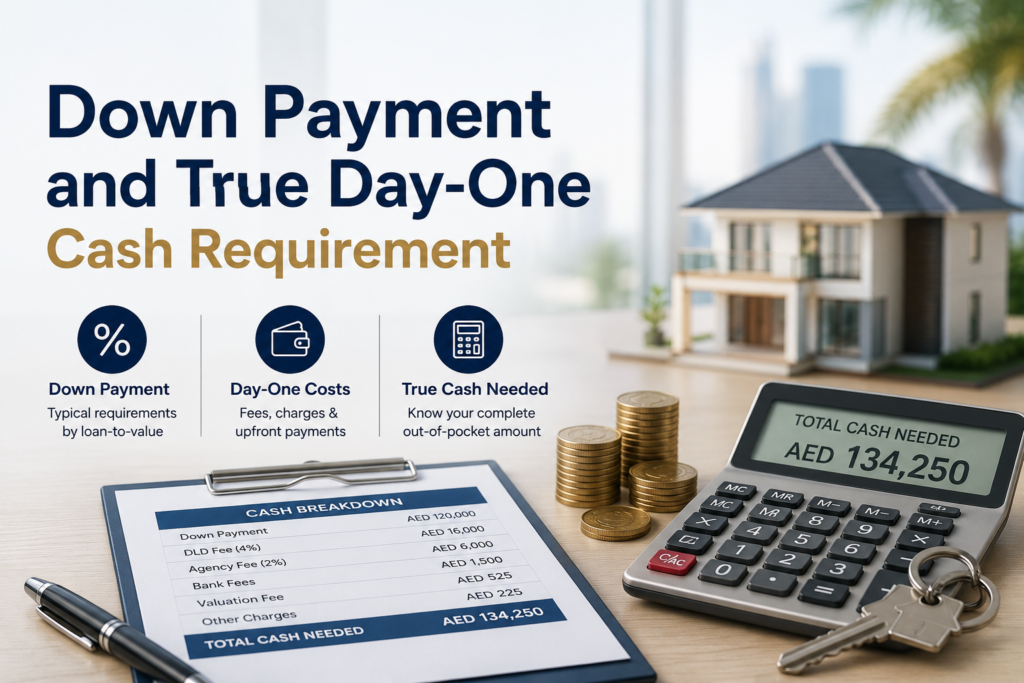
The down payment percentage is well known. The total cash required on the day of transfer is substantially higher and is where most first-time Dubai buyers are caught off guard. Every fee below is fixed by law or standard bank practice and cannot be financed into the mortgage.
LTV by buyer type and property value
| Buyer Type | Property under AED 5M | Property above AED 5M | Second property |
| UAE National | 85% LTV / 15% down | 70% LTV / 30% down | 65% LTV / 35% down |
| Expat Resident | 80% LTV / 20% down | 70% LTV / 30% down | 60% LTV / 40% down |
| Non-Resident | 60 to 65% LTV / 35 to 40% down | 55 to 60% LTV | Stricter, varies by bank |
True cash-on-day-one: worked example at AED 1.5M (expat resident, 20% down)
| Cost Item | Amount (AED) | Notes |
| Down payment (20% of AED 1.5M) | 300,000 | Loan: AED 1.2M |
| DLD transfer fee (4% of purchase price) | 60,000 | Mandatory, paid to DLD |
| DLD admin fee | 580 | Fixed fee |
| Mortgage registration fee (0.25% of loan + AED 290) | 3,290 | 0.25% of AED 1.2M + AED 290 |
| Property valuation fee | 2,500 to 3,500 | Commissioned by the bank |
| Real Estate Trustee Centre fee | 4,000 | Properties above AED 500K |
| Bank processing fee (0% to 1% of loan) | 0 to 12,000 | Many banks waive this |
| Home insurance (first year, required by bank) | 1,500 to 4,000 | Annual ongoing cost |
| TOTAL cash required on day one | Approx. AED 371,000 to 384,000 | Excluding agency fee |
On a AED 1.5M purchase with 20% down, the true cash requirement is approximately AED 371,000 to 384,000, not AED 300,000. If buying through an agent in the secondary market, add 2% agency fee (AED 30,000), bringing the total to approximately AED 401,000 to 414,000. Buying direct from a DLD-registered developer like Januss eliminates the agency fee entirely.
Current Mortgage Rates for Expats in Dubai: 2026
Dubai mortgage rates in 2026 are shaped by two dynamics: EIBOR (Emirates Interbank Offered Rate), which has been cooling from 4.0% to approximately 3.5% in early 2026, and individual bank risk pricing based on applicant profile. This makes 2026 one of the better rate environments of recent years for buyers locking in.
| Product Type | Expat Resident Rate | Non-Resident Rate | Fixed Period | After Fixed Period |
| Fixed rate (short) | From 3.49% | From 5.25% | 1 to 2 years | Reverts to variable |
| Fixed rate (medium) | 3.75% to 4.5% | 5.5% to 6.0% | 3 to 5 years | Reverts to variable |
| Variable (EIBOR + margin) | 4.5% to 5.8% | 5.5% to 6.5% | Ongoing | Adjusts quarterly |
| Islamic (Murabaha / Ijara) | From 3.25% | From 5.0% | Various | Profit rate fixed or variable |
Fixed vs variable in 2026: With EIBOR falling, variable-rate mortgages are becoming more competitive again. Most buyers choose a 3-year fixed period to lock in certainty through the near term and then reassess. A buyer who fixed for 5 years in 2023 at 4.8% is now paying above market; someone fixing for 3 years in early 2026 at 3.75% to 4.0% is in a reasonably strong position. As a general rule, if EIBOR is trending down, shorter fixed periods preserve the option to renegotiate sooner.
Which Banks Offer Expat Mortgages in Dubai?
No single bank is best for all expat profiles. The right lender depends on your employment type, income level, nationality, and loan size. Below is a profile-matched guide to the most active lenders for expats in 2026.
Emirates NBD: Broad product range covering residents and non-residents. Minimum income AED 15,000/month. Strong for Indian expats through the DirectRemit relationship with India. LTV up to 80% for residents.
HSBC Middle East: Preferred by international buyers and those with existing HSBC Premier relationships globally. Non-resident mortgage available up to AED 2M for Premier customers. Minimum income AED 15,000/month.
Mashreq Bank: Fastest digital pre-approval process in the market, typically 24 to 48 hours for complete files. Loans up to AED 10M for non-residents at up to 60% LTV. 25-year tenure available. Strong for self-employed applicants who prefer a streamlined digital process.
First Abu Dhabi Bank (FAB): Fixed-rate products up to AED 10M, tenure up to 25 years. Rate set by fixed period length. Good for buyers wanting a premium fixed-rate product over longer tenures.
Abu Dhabi Islamic Bank (ADIB): Leading Islamic home finance provider. Murabaha and Ijara structures, profit rates from 3.99%. Up to 80% LTV for residents. Digital pre-approval available. Strong for buyers who require Sharia-compliant financing.
Dubai Islamic Bank (DIB): Second major Islamic finance provider. Ijara (lease-to-own) structures. Open to all nationalities. Competitive profit rates in line with conventional fixed-rate products.
ADCB (Abu Dhabi Commercial Bank): Known for high LTV products for salaried expat residents. Competitive on rates for clean salaried profiles. Less active on self-employed or non-resident applications.
Approach 2 to 3 banks: Pre-approval is free at most banks and typically takes 2 to 5 working days with a complete document pack. Applying to multiple lenders simultaneously gives you competing offer letters to negotiate from. Do not sign any property agreement before you hold at least one pre-approval letter.
Eligibility for Salaried Expats
Salaried expats with a UAE residency visa and a stable employment record represent the most straightforward mortgage profile in Dubai. Banks compete actively for this segment.
Age: 21 to 65 years at end of loan term for salaried expats. A 45-year-old gets a maximum 20-year tenure; a 50-year-old, 15 years.
Minimum income: AED 10,000/month at some banks; AED 15,000/month at most major lenders. Employees of large multinationals listed on the bank’s approved employer list sometimes qualify at lower thresholds.
Employment: Permanent contract preferred. Probationary period employees are typically ineligible. Minimum 3 to 6 months in current role required at most banks.
AECB credit check: Banks run a credit check with the Al Etihad Credit Bureau. A clean record with no defaults is essential. Defaults, bounced cheques, or late payments on existing UAE facilities cause rejection at most lenders.
UAE residency visa: Must be valid. Some banks accept a visa renewal in progress with a letter from the employer.
Document checklist for salaried expats
- Valid passport copy
- UAE residency visa copy
- Emirates ID
- Salary certificate on employer letterhead (dated within 30 days)
- Last 3 months payslips
- Last 6 months UAE bank statements
- AECB credit report (banks pull this directly in most cases)
- Signed SPA or property details (once property is identified)
Eligibility for Self-Employed Expats: The Honest Picture
Self-employed expats can get mortgages in Dubai, but the process is stricter and the approval rate lower than for salaried applicants. Banks view variable income as higher risk and apply additional verification steps. Understanding what banks are actually looking for prevents wasted applications.
Trade licence valid for 2 or more years: An established business is required. A licence formed 6 months ago is not sufficient. Both free zone and mainland licences are accepted at most major banks.
Two years of audited financial statements: Must be prepared by a UAE-registered audit firm and carry an unqualified (clean) audit opinion. A qualified opinion indicating uncertainties or disputes will typically cause rejection.
Revenue must be consistent or growing: Declining revenue over 2 consecutive years is a significant red flag. Banks are not looking for profitability alone; they want to see income stability. A business showing strong revenue with a dip in year 2 requires explanation and may still result in rejection.
12 months of business bank statements: Banks require 12 months (not the 6 months required for salaried applicants) to assess cash flow consistency across a full business cycle.
Rate loading: Some banks apply a margin premium of 0.25% to 0.50% above their standard salaried rate for self-employed applicants to price the additional income risk.
Additional documents for self-employed applicants
- Valid UAE trade licence (free zone or mainland, 2+ years old)
- 2 years of audited financial statements with unqualified opinion
- Last 12 months business and personal bank statements
- Company ownership documents (MOA, share certificates)
- Personal income tax returns or equivalent (for non-UAE-resident income)
- Passport, Emirates ID, and UAE residency visa
Tip for self-employed buyers: If your business financials are complex or your revenue has been inconsistent, consider approaching a mortgage broker before going directly to banks. Brokers can pre-screen your file and direct you to the lenders most likely to approve your specific profile, saving you from hard AECB inquiries that can temporarily affect your credit score. For a guide to payment plan alternatives that bypass bank approval entirely, see below.
How Your Age Affects Maximum Tenure and Monthly Repayments
The UAE Central Bank removed its own age cap in 2019, but virtually all UAE banks apply their own internal limits: typically 65 years at end of term for salaried expats and 70 years for self-employed or UAE nationals. This age cap directly limits your maximum mortgage tenure, which in turn increases your monthly repayment and makes the DBR harder to clear.
Worked example: AED 1M loan at 4.5% interest rate.
| Applicant age | Max tenure (65yr cap) | Monthly repayment | DBR impact (AED 20K income) | Qualifies on DBR? |
| 35 years | 30 years | AED 5,067 | 25% of income | Yes |
| 45 years | 20 years | AED 6,326 | 32% of income | Yes |
| 50 years | 15 years | AED 7,650 | 38% of income | Yes |
| 55 years | 10 years | AED 10,360 | 52% of income | No (exceeds 50%) |
A 55-year-old expat earning AED 20,000/month fails the DBR test on an AED 1M loan due to the shortened tenure. The same buyer would need to either increase their income, reduce the loan amount, or increase their down payment to bring the monthly repayment below the 50% DBR threshold. This is not unusual in the Dubai expat market and is worth modelling before approaching a bank.
Buy-to-Let Mortgages for Expat Investors
Expats buying Dubai property to rent out rather than occupy can access buy-to-let (BTL) mortgages, but the terms are stricter than owner-occupier products.
LTV: 65% to 70% for expat residents (vs 80% for owner-occupier). Non-residents: 55% to 60%.
Rental income: Some banks accept projected or confirmed rental income as supplementary income evidence when calculating DBR, which can increase borrowing capacity.
Rate: Typically 0.25% to 0.50% higher than the equivalent owner-occupier product.
Documentation: Tenancy agreements or RERA-registered lease contracts may be requested as supporting evidence where rental income is being used in the DBR calculation.
For buy-to-let investors considering the rental yield and return on investment case for Dubai property more broadly, the full cost of buying guide covers the acquisition cost structure in detail.
Step-by-Step: How to Apply for a Mortgage in Dubai as an Expat
Run your self-assessment first. Calculate your DBR at 50% of gross monthly income to find your maximum monthly repayment. Then apply the 7x annual income cap. Take the lower figure as your true borrowing ceiling. Factor in the age-at-end-of-term limit to determine your maximum tenure, then recalculate monthly repayments at that tenure.
Organise your complete document pack. Gather the full checklist for your employment type before approaching any bank. Incomplete applications are the most common cause of delays. Create one digital folder, clearly labelled, with all documents scanned at high resolution. Keep all dated documents current (within 30 days where required).
Apply for pre-approval from 2 to 3 banks simultaneously. Pre-approval is free at most banks and takes 2 to 5 working days for a complete file. A pre-approval letter is valid for 60 to 90 days and states your maximum borrowing amount. Applying to multiple lenders simultaneously gives you competing offers to negotiate from and does not commit you to any one bank.
Use the pre-approval letter before signing anything. Do not sign an MOU, SPA, or pay any deposit on a property before holding at least one pre-approval letter. The pre-approval tells you your buying range and gives sellers confidence you are a credible buyer.
Select a property in a freehold zone. Dubai mortgages are only available for properties in DLD-registered freehold zones. Confirm freehold status with DLD records before committing.
Bank commissions a property valuation. Once you have a property in mind, the bank appoints a RERA-approved independent valuer. LTV is applied to the lower of the purchase price or the bank valuation. Budget AED 2,500 to 3,500 for this fee.
Receive and compare final offer letters. Once the valuation is complete, the bank issues a formal offer letter stating the loan amount, rate, tenure, monthly repayment, and any conditions. Compare all offer letters before accepting. Pay attention to early settlement penalties (typically 1% of outstanding balance or AED 10,000, whichever is lower).
Sign the Sales Purchase Agreement (SPA). The SPA is the binding contract between buyer and seller. A conveyancing lawyer should review this before signing.
Complete the DLD transfer and mortgage registration. The transfer is completed at a Real Estate Trustee Centre. Pay the DLD transfer fee (4%), mortgage registration fee (0.25% of loan + AED 290), and trustee fee. The title deed is issued in your name with the mortgage lien registered.
Timeline: Pre-approval takes 2 to 5 working days for complete files. Full process from application to title deed typically takes 4 to 6 weeks for salaried applicants with clean documentation. Self-employed and non-resident applications typically take 6 to 8 weeks. Factor in additional time if foreign documents require apostille and MOFA attestation.
When a Developer Payment Plan Beats a Bank Mortgage
For expat buyers considering off-plan property specifically, a developer payment plan can be a structurally better financing route than a bank mortgage. This is the one option that most mortgage guides do not address, because brokers and portals have no commercial incentive to recommend it. As a DLD-registered developer, Januss can explain it honestly.
| Factor | Bank Mortgage | Developer Payment Plan (Off-Plan) |
| Interest cost | Yes: paid over full loan term at market rates | None: zero interest on instalment schedule |
| DBR check | Required: must pass 50% DBR cap | Not required: no bank involvement |
| AECB credit check | Required | Not required |
| LTV constraint | 20% to 40% down depending on profile | Typically 10% to 20% at booking, balance phased |
| Bank processing fee | 0% to 1% of loan amount | None |
| Mortgage registration fee | 0.25% of loan + AED 290 | None |
| EIBOR / rate risk | Yes: variable-rate products move with EIBOR | None: fixed instalments |
| Buyer fund protection | Bank-secured, title deed at completion | RERA escrow-protected, DLD-supervised escrow account |
| Golden Visa eligibility | Eligible once DLD valuation reaches AED 2M | Eligible once paid instalments reach AED 2M |
For self-employed buyers who struggle with audited financials or declining revenue, buyers whose age limits their mortgage tenure, or investors who want to eliminate rate risk entirely on a new project, a developer payment plan removes all of those barriers in one move.
RERA protection: Under RERA Law No. 8 of 2007, all buyer payments on DLD-registered off-plan projects go into a government-supervised escrow account, not directly to the developer. Funds are released to the developer only as verified construction milestones are confirmed. This is the same protection that applies to every DLD-registered off-plan development including all Januss projects.
Mortgaged Property and the Golden Visa
If your mortgaged property carries a DLD-certified value of AED 2 million or more, you may qualify for the UAE Golden Visa, the 10-year renewable UAE residency permit.
A key 2026 update: since February 2026, the old requirement that mortgage holders must have paid at least 50% of the property value before applying has been removed. The eligibility test is now the DLD-certified valuation alone, regardless of how much remains on the mortgage. A bank NOC is required from the lender, and DLD registers a lien on the property at the time of visa issuance.
For expat buyers specifically, the Golden Visa removes the need to renew a residency visa tied to an employer, providing long-term residency security that is independent of your employment situation.
FAQ: Dubai Mortgage for Expats
Can expats get a mortgage in Dubai?
Yes. UAE-resident expats with a valid residency visa, stable income, and clean credit history can access up to 80% LTV on a first property under AED 5 million. Non-residents can also borrow, at 60 to 65% LTV, from select banks with dedicated non-resident products. The process is governed by the UAE Central Bank and is well-established.
What is the minimum salary to get a mortgage in Dubai as an expat?
Most major UAE banks set a minimum monthly income of AED 15,000 for expat mortgage applicants. Some banks lower this to AED 10,000 for employees of large multinationals on their approved employer lists. For non-residents, the equivalent of AED 15,000 per month in foreign currency income is typically required.
What is the maximum I can borrow as an expat in Dubai?
Two limits apply simultaneously: your total monthly debt obligations including the mortgage cannot exceed 50% of gross monthly income (the DBR cap), and the total loan cannot exceed seven times your annual gross income (the CBUAE income cap). The lower of the two amounts is your maximum borrowing. Banks apply both and will lend up to whichever limit is reached first.
How long does a Dubai mortgage take to process?
Pre-approval takes 2 to 5 working days for complete files at most banks. The full process from application to title deed typically takes 4 to 6 weeks for salaried applicants and 6 to 8 weeks for self-employed or non-resident applications. Additional time is required if foreign documents need apostille and MOFA attestation.
Can self-employed expats get a mortgage in Dubai?
Yes, but the requirements are stricter. You need a UAE trade licence valid for 2 or more years, 2 years of audited financials with an unqualified audit opinion, 12 months of bank statements, and revenue that is consistent or growing. Declining revenue over 2 consecutive years typically results in rejection. Some banks apply a rate premium of 0.25% to 0.50% above the standard rate for self-employed applicants.
What happens to my Dubai mortgage if I leave the UAE?
If you leave the UAE and lose your residency visa, most banks will convert your resident mortgage into a non-resident product, typically adjusting the rate upward. You must notify your bank as soon as your residency status changes. Ceasing payments without notification creates a significantly worse outcome: banks can pursue the outstanding balance through UAE courts and report the default to AECB, affecting your UAE credit record.
Can I get a Dubai mortgage as a non-resident?
Yes, at 60 to 65% LTV (35 to 40% down payment). Select banks including Mashreq, Emirates NBD, HSBC, and FAB offer non-resident mortgage products. Documentation requirements are more extensive: international bank statements, overseas credit reports, income tax returns, and income may be subject to a discount by some banks to account for exchange rate risk.
Is an Islamic mortgage available to expats in Dubai?
Yes. Islamic home finance products (Murabaha and Ijara structures) are available to all nationalities at Dubai Islamic Bank and Abu Dhabi Islamic Bank. They are open to expat residents and are broadly comparable to fixed-rate conventional mortgages in terms of monthly cash flow. The underlying structure differs (no interest charged; instead a profit markup or lease-based structure), but the practical payment profile is similar.
What is the DBR limit for Dubai mortgages?
The Debt Burden Ratio cap is 50% of gross monthly income, set by the CBUAE. Your total monthly debt obligations, including the new mortgage instalment, car loans, personal loans, and credit card minimums, cannot exceed half your gross monthly income. The separate 7x annual income cap also applies simultaneously. Banks calculate both and use whichever produces the lower borrowing ceiling.
Buying Off-Plan in Dubai Without a Bank Mortgage
If you are an expat exploring Dubai property and a bank mortgage feels complex, expensive, or inaccessible for your profile, a developer payment plan on an off-plan project removes every bank constraint from the equation: no DBR check, no credit search, no rate risk, and no mortgage registration fee. Browse Januss Developers current off-plan projects to see the current pipeline, or speak with our team directly about which payment plan structure works for your situation.
Resources & Official References
UAE Central Bank — Mortgage Regulations
The primary regulatory source for all LTV limits, DBR caps, and income multiplier rules.
https://rulebook.centralbank.ae/en/rulebook/regulations-regarding-mortgage-loans
UAE Central Bank — 2019 LTV Amendment (80% for expats)
The amendment that raised the expat first-property LTV from 75% to 80%.
https://rulebook.centralbank.ae/en/rulebook/amendments-circular-no-312013-regulations-regarding-mortgage-loans-0
Dubai Land Department — Official Website
Property registration, mortgage registration, title deed services, and freehold zone information.
https://dubailand.gov.ae/en/
DLD — Mortgage Registration Service
Official DLD page for mortgage registration requirements and fees (0.25% of loan + AED 290).
https://dubailand.gov.ae/en/eservices/request-for-mortgage-registration/
DLD — Property Sale Registration
Step-by-step DLD transfer process and trustee office requirements.
https://dubailand.gov.ae/en/eservices/property-sale-registration/
DLD — Golden Visa for Property Investors
Official DLD page for the 10-year Golden Visa via property investment (AED 2M threshold).
https://dubailand.gov.ae/en/eservices/request-for-golden-visa-investor/
ICP (Federal Authority for Identity & Citizenship) — Golden Visa
Federal-level Golden Visa application portal and category details.
https://icp.gov.ae/en/golden-visa/
AECB — Al Etihad Credit Bureau
Check your UAE credit score and report before applying for a mortgage.
https://www.aecb.gov.ae
UAE Government Portal — Credit Report Guide
Official u.ae guide to obtaining an individual or company credit report through AECB.
https://u.ae/en/information-and-services/business/financial-credibility-for-individuals-and-companies
Dubai Law No. 8 of 2007 — Escrow Account Law (Full Text)
The legislation underpinning RERA escrow protection for all off-plan buyers.
https://dlp.dubai.gov.ae/Legislation%20Reference/2007/Law%20No.%20(8)%20of%202007.html