

Quick Answer: Dubai averages 6 to 8% gross rental yield and 4.5 to 6% net yield in 2026, well above London (2.5 to 4%), New York (3 to 5%), and Singapore (2 to 3%). But the average conceals a 4 to 5 percentage point spread between communities. The highest yields sit in affordable mid-market areas such as International City, Dubai Silicon Oasis, and JVC (7 to 11% gross). The lowest sit in prime lifestyle areas such as Palm Jumeirah and Downtown Dubai (3.5 to 6% gross). Studios and 1-bedrooms consistently outperform larger units. And since Dubai charges zero personal income tax on rental income, the after-tax advantage over comparable global markets is even wider than the gross yield numbers suggest.
Dubai’s rental market matured significantly after the rapid price growth of 2022 to 2024.
Investors who entered that cycle on the assumption that anything would yield well are now dealing with a more nuanced reality: service charges have risen, supply in certain communities has increased, and the difference between a well-selected and poorly-selected property can be 2 to 3 percentage points of annual net yield.
That nuance is what this guide is built around. Not the headline 8 to 10% gross numbers that appear in developer brochures, but the actual net yield after service charges, management, vacancy, and in some cases, mortgage repayments.
The data below reflects Q1 2026 market conditions across Dubai’s major residential communities.
Januss note: As a DLD-registered developer operating in Al Furjan, a community entirely absent from most yield guides despite consistently strong rental performance, we have direct knowledge of the mid-market yield picture that broker-led content tends to skip.
Gross Yield vs Net Yield: The Number That Actually Matters
Most yield figures quoted in property marketing are gross. Gross yield is a quick screening metric. Net yield is what actually lands in your account, and for investment decisions, it is the only number that matters.
The formula for each
Gross yield: Annual rent divided by purchase price, expressed as a percentage. Example: AED 80,000 annual rent on a AED 1,000,000 property = 8% gross yield.
Net yield: Annual rent minus all operating costs, divided by purchase price. The same property with AED 18,000 in service charges, AED 6,400 in management fees (8%), and AED 3,000 in maintenance gives a net income of AED 52,600 and a net yield of 5.26%.
What net yield deducts from gross
Service charges: The biggest variable. AED 12 to 18 per sqft in affordable areas (JVC, Al Furjan). AED 25 to 35 per sqft in premium areas (Downtown, DIFC). On a 1,000 sqft apartment: AED 12,000 to 35,000 per year.
Property management fee: 5 to 10% of annual rent if using a management company. Common for international investors without local presence.
Vacancy allowance: 2 to 4 weeks per year is typical for well-located properties. Budget 4 to 8% of potential annual rent.
Maintenance and snagging: 1 to 2% of property value annually for ongoing upkeep and tenant wear.
Insurance: AED 1,500 to 4,000 per year for standard property insurance.
Rule of thumb for 2026: Net yield is typically 1.5 to 2.5 percentage points below gross. A headline 8% gross yield in JVC translates to approximately 5.5 to 6% net. A headline 6% gross yield in Downtown translates to approximately 3.5 to 4.5% net, because service charges in premium buildings consume a much larger share of rental income.
What Is a Good Rental Yield in Dubai in 2026?
The benchmark has shifted as Dubai’s market has matured. The consensus among analysts and investors active in the market in early 2026:
| Net Yield Range | Assessment | Typical Area/Profile |
| Below 4% | Weak for cash flow | Downtown, Palm Jumeirah, DIFC high-end units |
| 4% to 5% | Acceptable (appreciation play) | Downtown, Dubai Marina premium buildings, Palm |
| 5% to 6% | Strong and stable | Dubai Marina, Business Bay, Dubai Hills, JLT |
| 6% to 8% | Excellent | JVC, Al Furjan, Arjan, Dubai Silicon Oasis |
| 8% to 10%+ | High-performing | International City, DLRC, Discovery Gardens |
For context: a 5% net yield in Dubai on a zero-income-tax basis is equivalent to a pre-tax yield of approximately 7 to 8% in the UK or US at standard marginal tax rates. The tax-free advantage is not cosmetic. It is structurally significant.
Dubai Rental Yield by Area: 2026 Data Table
The table below reflects gross yield ranges, typical service charges, and approximate net yields based on Q1 2026 transaction and rental data. All figures are for apartments unless otherwise noted. Yields vary within each area by building quality, floor level, furnishing status, and management approach.
| Area | Gross Yield | Service Charge (AED/sqft) | Net Yield (approx.) | Best Unit Type | Appreciation Profile |
| International City | 9 to 11% | AED 8 to 12 | 7 to 9% | Studio, 1BR | Low |
| Dubai Silicon Oasis | 8 to 10% | AED 10 to 14 | 6 to 8% | Studio, 1BR | Low to Medium |
| JVC (Jumeirah Village Circle) | 7 to 9% | AED 12 to 18 | 5.5 to 6.5% | Studio, 1BR | Medium |
| Al Furjan | 7 to 9% | AED 12 to 16 | 5.5 to 7% | 1BR, 2BR | Medium to Strong |
| Arjan | 7 to 9% | AED 10 to 15 | 5.5 to 7% | 1BR | Medium |
| JLT (Jumeirah Lake Towers) | 6 to 8% | AED 14 to 20 | 5 to 6% | 1BR, 2BR | Medium |
| Business Bay | 7 to 9% gross / 3.8 to 5.3% net | AED 18 to 28 | 3.8 to 5.3% | Studio, 1BR | Strong |
| Dubai Marina | 5 to 7% | AED 14 to 22 | 3.8 to 5.5% | 1BR (waterfront) | Strong |
| Dubai Hills Estate | 5 to 7% | AED 14 to 20 | 4 to 5.5% | 1BR, 2BR | Strong |
| Downtown Dubai | 4 to 6% | AED 16 to 28 | 3.2 to 4.8% | Studio | Very Strong |
| Palm Jumeirah | 3.5 to 5% | AED 20 to 35 | 2.5 to 4% | Apartment (STR) | Very Strong |
Business Bay caveat: Business Bay gross yields look high on paper (7 to 9%) but compress sharply once district cooling, high service charges, and management costs are applied. Net yield of 3.8 to 5.3% is the realistic range. The area suits investors prioritising capital appreciation and corporate tenant quality over immediate cash flow.
Rental Yield by Property Type
The type of property you buy within any given area is as important as the area itself. The pattern is consistent across Dubai: smaller units deliver higher gross yields because entry prices are lower while rental demand per square metre remains strong.
| Property Type | Typical Gross Yield | Typical Net Yield | Best Communities | Notes |
| Studio | 7 to 9% | 5.5 to 7% | JVC, DSO, Al Furjan | Lowest entry price; fastest re-letting; consistent demand from young professionals |
| 1-bedroom apartment | 6 to 8% | 5 to 6.5% | JVC, Marina, Bay | Most liquid resale asset in Dubai; strong tenant demand across all segments |
| 2-bedroom apartment | 5.5 to 7% | 4 to 5.5% | Dubai Hills, JVC | Family demand; higher service charge per unit; slightly slower re-letting |
| 3-bedroom apartment | 4.5 to 6% | 3.5 to 4.5% | Dubai Marina, Downtown | Limited tenant pool; strong demand in specific premium buildings only |
| Villa / townhouse | 4 to 6% | 3 to 5% | Arabian Ranches, DAMAC Hills | Higher entry price; maintenance-intensive; seasonal demand; strong appreciation |
The studio and 1-bedroom gap over larger units narrows significantly on a net basis once higher service charges (larger units have proportionally higher absolute charges) and maintenance costs are factored in. Even so, the 1-bedroom remains the most consistent yield performer across Dubai communities in 2026.
The Service Charge Factor: Why Two Identical Gross Yields Are Not the Same
Service charges are the single most underestimated variable in Dubai yield calculations. Two 1,000 sqft apartments in different buildings, both renting for AED 80,000 per year, can deliver very different net yields depending entirely on their service charge rate.
Worked example: same gross yield, different service charges
| Item | JVC Building A (chiller-free) | Business Bay Building B (district cooled) |
| Purchase price | AED 1,000,000 | AED 1,000,000 |
| Annual rent | AED 80,000 | AED 80,000 |
| Gross yield | 8.0% | 8.0% |
| Service charge (AED 14/sqft vs AED 28/sqft) | AED 14,000 | AED 28,000 |
| Management (8%) | AED 6,400 | AED 6,400 |
| Maintenance + insurance | AED 4,000 | AED 4,000 |
| Total annual costs | AED 24,400 | AED 38,400 |
| Net income | AED 55,600 | AED 41,600 |
| Net yield | 5.56% | 4.16% |
Same purchase price, same rent, same gross yield: a 1.4 percentage point net yield gap. Over 10 years on a AED 1M investment, that is approximately AED 140,000 in additional income from the lower-service-charge building.
The chiller-free advantage
Buildings without district cooling (chiller-free) pass DEWA cooling costs directly to tenants rather than embedding them in service charges. For a yield-focused investor, chiller-free buildings in JVC, Al Furjan, and Arjan often deliver meaningfully better net yields than technically comparable buildings elsewhere. You can verify a specific building’s service charge rate through the RERA service charge index at dubailand.gov.ae before committing to a purchase.
Al Furjan Rental Yield: The Mid-Market Case
Al Furjan is conspicuously absent from most rental yield guides published by brokers and portals. This is partly because it does not fit the premium narrative and partly because brokers earn higher absolute fees on higher-value transactions. For yield-focused investors, the omission is significant.
Al Furjan delivers gross yields of 7 to 9% for apartments and 5 to 6% for villas. Service charges sit at the lower end of Dubai averages (AED 12 to 16 per sqft for most buildings), meaning the gap between gross and net is narrower than in comparable-yield communities like Business Bay. Net yields for well-selected 1-bedroom apartments in Al Furjan typically sit at 5.5 to 7%.
Several structural factors support Al Furjan’s rental demand:
Metro connectivity: The Al Furjan Metro Station on the Route 2020 extension connects residents directly to the Red Line and onward to business districts, the airport, and Dubai Marina. Metro access is a consistent predictor of rental demand.
Mid-market tenant profile: Al Furjan attracts salaried professionals and young families priced out of Business Bay and JVC. This tenant profile tends toward longer tenancy periods and lower turnover.
Entry pricing: 1-bedroom apartments in Al Furjan are accessible from AED 700,000 to AED 950,000, significantly below equivalent-yield options in Business Bay or Dubai Marina.
Chiller-free buildings: A significant proportion of Al Furjan’s residential stock is chiller-free, which supports net yield performance.
Januss note: Januss Developers is based in Al Furjan. Our current off-plan projects in the community are priced at entry points that reflect the mid-market yield case, and all comply with DLD and RERA requirements with buyer payments protected in government-supervised escrow.
Short-Term vs Long-Term Rental in Dubai: Which Earns More?
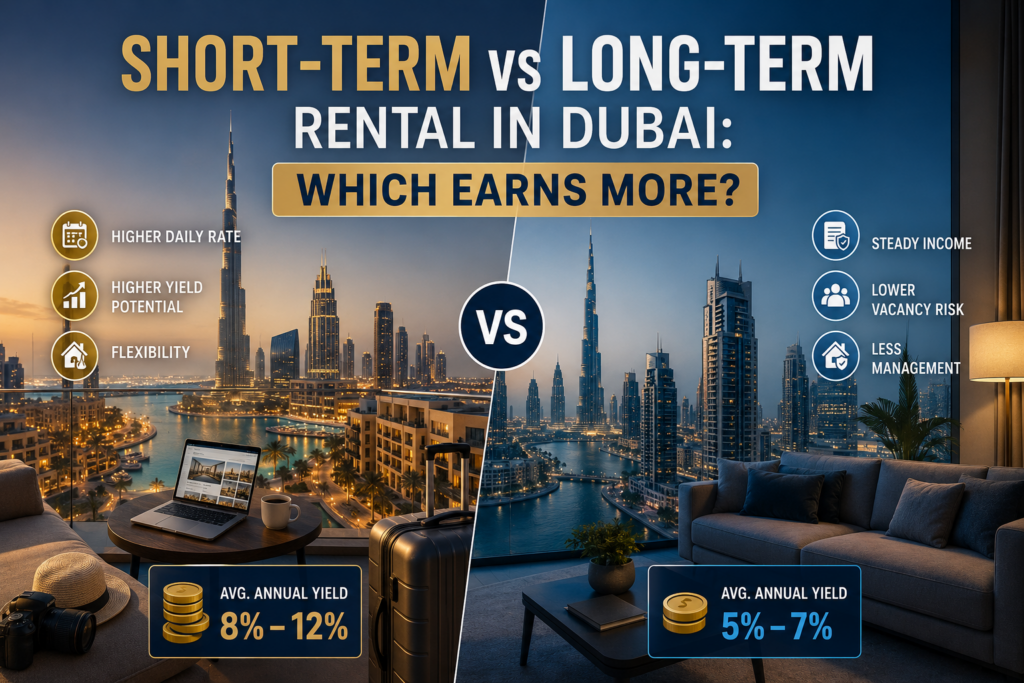
Short-term rental (Airbnb, holiday home) is the most common conversation starter among Dubai property investors in 2026. The gross numbers are real: well-managed 1-bedroom units in Dubai Marina can achieve 10 to 14% gross yield through STR versus 5 to 7% on annual leases. But the net comparison is far closer.
The full cost structure for each strategy
| Factor | Short-Term Rental (STR) | Long-Term Rental (LTR) |
| Gross yield (tourist area, 1BR) | 10 to 14% | 5 to 7% |
| Management fee | 15 to 25% of revenue | 5 to 8% of annual rent |
| DTCM holiday home permit | AED 1,520 to 5,040/year | Not required |
| Maintenance and wear | 5 to 8% of revenue (furnishing + turnover) | 1 to 2% of property value |
| Occupancy risk | Seasonal (70 to 80% average annual) | Lower (2 to 4 weeks void/year) |
| Net yield (tourist area, 1BR) | 6 to 9% | 4 to 5.5% |
| Operational complexity | High (24/7 guest management) | Low |
Worked example: AED 1.4M, 1-bedroom, Dubai Marina
Under STR management at 75% occupancy (274 nights) at an average AED 480 per night:
Gross revenue: AED 131,520
Management (20%): AED 26,304
DTCM permit: AED 3,000
Maintenance and furnishing amortisation: AED 9,000
Service charges: AED 19,000
Net income: AED 74,216 (net yield: 5.3%)
Under LTR at market rent AED 95,000 per year:
Annual rent: AED 95,000
Management (7%): AED 6,650
Maintenance: AED 5,000
Service charges: AED 19,000
Net income: AED 64,350 (net yield: 4.6%)
The STR advantage in this scenario is 0.7 percentage points of net yield, equivalent to AED 9,866 in additional annual income. Whether that premium justifies the significantly higher operational involvement depends on the investor’s capacity and preference. For passive income investors, LTR is typically the stronger choice.
Regulatory note: All short-term rentals in Dubai require a DTCM (Department of Tourism and Commerce Marketing) holiday home permit. Fines for unlicensed STR operations are AED 5,000 or more per violation. Not all buildings permit STR. Check the building’s master community rules before planning an STR strategy.
The Mortgage Math: When High Yield Does Not Mean Positive Cash Flow
This is the section that most Dubai yield articles omit entirely, yet it is the most important calculation for any buyer using leverage.
A high gross yield does not guarantee a cash-flow positive investment if you are financing with a mortgage. The relationship between your mortgage rate, your LTV, and your net yield determines whether the property generates or costs you money each month in the early years.
Worked example: AED 1.5M property, 20% down, 4.5% mortgage rate, 25-year tenure
| Item | Amount | Notes |
| Purchase price | AED 1,500,000 | |
| Down payment (20%) | AED 300,000 | Plus AED 85,000 in fees |
| Loan amount | AED 1,200,000 | |
| Monthly mortgage repayment (4.5%, 25yr) | AED 6,650 | AED 79,800/year |
| Annual rent (6% gross yield) | AED 90,000 | AED 7,500/month |
| Annual costs (service charge + management + maintenance) | AED 28,000 | Approximate mid-market figure |
| Net rental income | AED 62,000 | AED 5,167/month |
| Monthly cash flow (net rent minus mortgage) | Negative AED 1,483 | Monthly shortfall in early years |
A 6% gross yield property bought at 80% LTV at 4.5% generates a monthly shortfall of approximately AED 1,483. This is not catastrophic. Rental income typically escalates over time, and the mortgage balance reduces, improving cash flow in later years. But an investor who entered expecting passive income will face an early period of capital contribution.
Cash-flow neutrality at 80% LTV and 4.5% requires a gross yield of approximately 7.5% or above. This narrows the qualifying geography to JVC, Al Furjan, Arjan, and the higher-yield affordable communities.
Important: Always model cash flow under your specific LTV, rate, and service charge scenario before buying. Do not rely on gross yield alone. For buyers exploring mortgage financing options, the mortgage article covers the full eligibility, rate, and cost structure in detail.
Off-Plan Entry Price as a Yield Enhancer
This is the one angle that every broker-produced yield guide misses, because brokers earn commissions on both off-plan and secondary market sales and have no reason to make a comparative case.
Off-plan buyers who purchase at launch pricing typically pay 10 to 15% below comparable ready-property values. Since rental market rates are set by the ready market, an off-plan buyer’s effective yield on their actual purchase cost is proportionally higher. This is best understood with a direct comparison.
| Off-Plan Purchase (launch price) | Secondary Market (ready property) | |
| Purchase price | AED 900,000 | AED 1,050,000 |
| Annual market rent | AED 80,000 | AED 80,000 |
| Gross yield on cost | 8.9% | 7.6% |
| Net yield on cost (approx.) | 6.5 to 7% | 5.5 to 6% |
| Day-one capital position | Immediate paper gain at market value | At market value |
The yield advantage compounds: the off-plan buyer earns a higher yield on cost and benefits from the capital gain built in at launch pricing by the time the property is ready. Payment plans spread the capital over the construction period, improving the return on capital deployed at any given point in time.
All Januss Developers off-plan projects operate under RERA Law No. 8 of 2007. Every buyer payment goes into a DLD-supervised escrow account and is released to the developer only as construction milestones are independently verified. This is the same protection standard that applies to every DLD-registered developer in Dubai. See our guide to off-plan payment plans for the full structure.
Total Return: Yield Plus Capital Appreciation
Yield alone is an incomplete investment metric. An investor holding a property for 5 to 10 years needs to consider rental income and capital appreciation together.
The trade-off is consistent: high-yield affordable communities deliver lower appreciation rates. Prime communities deliver lower yields but stronger capital value growth. The optimal choice depends on the investor’s hold period and income requirements.
| Community | Net Yield | 5yr Appreciation (CAGR approx.) | 5yr Cumulative Return | Investor Profile | Liquidity |
| International City | 7 to 9% | 2 to 4% | 45 to 65% | Cash flow maximiser | Medium |
| JVC | 5.5 to 6.5% | 7 to 10% | 55 to 75% | Balanced | High |
| Al Furjan | 5.5 to 7% | 8 to 12% | 65 to 85% | Balanced, mid-market | Good |
| Dubai Marina | 4 to 5.5% | 10 to 14% | 70 to 90% | Appreciation + income | Very High |
| Downtown Dubai | 3.2 to 4.8% | 14 to 20% | 80 to 115% | Appreciation play | Very High |
| Palm Jumeirah | 2.5 to 4% | 15 to 22% | 80 to 120% | Capital store / STR | High |
On a 5-year total return basis, the apparent yield gap between mid-market and premium communities narrows considerably once capital appreciation is included. JVC and Al Furjan remain competitive on total return while offering superior early-year cash flow for investors who need income from day one.
Dubai vs Global Markets: The Tax-Free Advantage
Dubai’s gross yields are already substantially above comparable global cities. The tax-free advantage amplifies the differential further once after-tax returns are compared.
| Market | Gross Yield | Net Yield | Income Tax | CGT | After-Tax Net | Notes |
| Dubai | 6 to 8% | 5 to 6.5% | 0% | 0% | 5 to 6.5% | Personal holding |
| London (UK) | 2.5 to 4% | 2 to 3% | 20 to 40% | 18 to 28% | 1.2 to 2.4% | Basic to higher rate |
| New York (US) | 3 to 5% | 2 to 3.5% | 22 to 37% | 15 to 23.8% | 1.4 to 2.7% | Federal + State |
| Singapore | 2 to 3% | 1.5 to 2.5% | 17% (approx.) | 0% | 1.2 to 2% | No CGT on property |
| Dubai (corporate) | 6 to 8% | 5 to 6.5% | 9% above AED 375K | 0% | 4.5 to 6% | Corporate holding structure |
For a UK-based investor in the higher rate tax band, a 5% net yield in Dubai is equivalent to approximately 8.3% pre-tax in the UK. For a US investor at 32% federal plus state tax, the equivalent is approximately 7.4% pre-tax. The structural advantage is not marginal.
Corporate structure note: Investors holding Dubai property through a corporate structure (UAE LLC or holding company) face 9% UAE corporate tax on net rental income above AED 375,000 per year under the 2023 corporate tax framework. Personal holdings remain tax-free. For portfolio investors with multiple properties, the holding structure decision is material and warrants specialist advice.
Golden Visa Consideration for Yield Investors
For yield investors purchasing at or above the AED 2 million threshold, the UAE Golden Visa is a material secondary benefit. The 10-year renewable residency permit requires no employer sponsor, has no minimum UAE stay requirement, and covers the investor’s immediate family.
Since February 2026, mortgaged properties qualify for the Golden Visa based on DLD-certified valuation alone, regardless of how much equity has been paid. An investor buying a AED 2.1M property with 20% down qualifies immediately. The DLD registers a lien on the property to ensure it is not sold without addressing the visa relationship.
For international investors who intend to spend time in Dubai or want long-term residency security independent of employment, the Golden Visa adds a dimension to the investment case that yield-focused analysis alone does not capture.
FAQ: Dubai Rental Yield 2026
What is the average rental yield in Dubai in 2026?
The average gross rental yield for apartments in Dubai is 6 to 8% in 2026, depending on area and property type. Net yields after service charges, management, and vacancy typically sit at 4.5 to 6%. Studios and 1-bedrooms outperform larger units. High-yield communities like JVC, Al Furjan, and International City deliver above-average returns. Prime areas like Downtown Dubai and Palm Jumeirah deliver lower yields but stronger capital appreciation.
Which area has the highest rental yield in Dubai?
International City and Dubai Logistics and Retail Corridor (DLRC) currently deliver the highest gross yields at 9 to 11%, reflecting low entry prices and consistently strong tenant demand. Dubai Silicon Oasis (8 to 10%) and JVC (7 to 9%) follow closely. These areas trade lower capital appreciation potential against higher immediate income. For investors wanting both solid yield and appreciation, Al Furjan (7 to 9% gross, medium-strong appreciation) and JVC represent the most balanced options in 2026.
What is the difference between gross and net yield in Dubai?
Gross yield is annual rent divided by purchase price. Net yield deducts service charges, property management fees, vacancy, maintenance, and insurance. In Dubai, the gap between gross and net is typically 1.5 to 2.5 percentage points. The gap is wider in premium areas with high service charges (AED 25 to 35 per sqft) and narrower in affordable communities with lower service charges (AED 12 to 16 per sqft).
Do I pay tax on rental income in Dubai?
No. Dubai levies zero personal income tax on rental income for individual property holders. There is also no capital gains tax on property sales. For investors using a corporate holding structure, UAE corporate tax at 9% applies to net rental income above AED 375,000 per year. The zero personal tax rate makes Dubai’s after-tax yield substantially higher than comparable figures in the UK, US, or most European markets.
Is short-term rental more profitable than long-term in Dubai?
On a gross basis, yes: STR can deliver 10 to 14% gross yield versus 5 to 7% for LTR in tourist locations. On a net basis, the gap narrows considerably once DTCM licensing, higher management fees (15 to 25%), furnishing costs, and seasonal vacancy are accounted for. The net premium of STR over LTR is typically 0.7 to 2 percentage points in well-performing tourist areas. STR requires significantly more active management and is not suitable for passive income investors.
What is a good rental yield in Dubai?
In 2026, a net yield of 5 to 6% is considered strong and stable. Net 6 to 8% is excellent. Net 8 to 10% is high-performing but limited to specific affordable communities. Below 4% net is weak for cash flow purposes and only makes sense as part of a capital appreciation strategy. For investors using mortgage financing, the effective cash-flow threshold is higher: you need approximately 7.5% gross yield or above to achieve monthly cash-flow neutrality at 80% LTV and a 4.5% mortgage rate.
How do service charges affect net yield?
Service charges are the single biggest variable in converting gross to net yield in Dubai. Premium buildings in Downtown and DIFC charge AED 25 to 35 per sqft annually, which on a 1,000 sqft unit means AED 25,000 to 35,000 per year in operating costs before management or maintenance. Affordable communities like JVC and Al Furjan charge AED 12 to 18 per sqft. This difference alone creates a 1 to 2 percentage point net yield gap between otherwise identical properties. Always request the specific building’s confirmed service charge rate before purchasing.
Can I get a mortgage on a Dubai investment property and still be cash-flow positive?
It depends on the yield, LTV, and mortgage rate. At 80% LTV and 4.5%, a property needs approximately 7.5% gross yield to break even on monthly cash flow after service charges and management. At lower LTV (50 to 60%), the monthly repayment drops sufficiently for 6% gross yield properties to be cash-flow neutral. Higher-yield communities like JVC and Al Furjan support positive cash flow at standard LTV levels better than Downtown or Dubai Marina. Always model cash flow under your specific scenario before committing.
Investing in Dubai Property with Januss Developers
For yield-focused investors evaluating Al Furjan or other mid-market Dubai communities, buying off-plan directly from a DLD-registered developer gives you two advantages: launch pricing that enhances your effective yield on cost, and no agency fee (the standard 2% on the purchase price). Browse Januss Developers current off-plan projects to see current availability and pricing, or speak with our team to discuss which unit type and community best suits your yield and total return objectives.
For further context on the full cost of acquiring Dubai property, the complete buying cost guide covers DLD fees, registration, and all acquisition costs that affect your effective yield on capital deployed. And for investors considering freehold zones open to foreign ownership, the freehold areas guide maps every eligible community in Dubai.